Monday, April 11, 2022

Library Hours Six Months Later, part III: Public libraries, farther from Seattle

Dear Diary,

I hope you had, sigh, good nights and day.  This part of this page concerns six libraries - well, three individual libraries and three multi-branch systems - which appear to offer free library cards to most Washingtonians with or without reciprocity, as Sno-Isle Libraries, Kitsap Regional Library, Timberland Regional Library and Puyallup Public Library from the previous part also appear to.

I can't help thinking that it's possible that these mostly smaller libraries only say that because they haven't experienced the rapacity Seattleites, in particular, are known for in matters biblioholic (that's why we aren't allowed many holds at the King County Library System, for example).  So I have two public service intentions for this part of this page:  to let readers know about these libraries where we may be able to get cards; but also, to notify these libraries' staff in case they don't actually mean what they say that suggests we might be able to get cards.

All six, as well as all the libraries in the list, at the end of this part, of public libraries in western Washington that definitely don't offer Seattleites free cards at all, are even farther away from my house than PPL, furthest in the previous part, and the first two are across Puget Sound as well.  Even though my house isn't actually at the centre of Seattle, for practical purposes that means the Seattle Public Library, however short its list of reciprocal borrowing agreements may be compared to some places, has actually negotiated them with all public libraries within a reasonable distance of Seattle.  (The closest east beyond KCLS - Roslyn and Leavenworth - are both twice as far as PPL, so yes, this is definite.)

In the previous part, I commented on some libaries' codes of conduct, but not others'.  I continued that in first writing this part until it led me to say something that turned out not to be true.  So I've taken all that out, and intend a separate part about library codes of conduct in relation to homeless people, focusing on the nine in the previous part and these next six.

The Port Townsend Public Library

The Port Townsend Public Library is a single-building institution, 36.58 miles from my house according to this distance calculator, but it's more prominent than most such in western Washington.  It lists reciprocal borrowing agreements with KCLS and KRL from the last part of this page, and with the North Olympic Library System, up next.  It doesn't even bother to list its links to Jefferson County Library as reciprocal.  Those two libraries are joined at the hip in many ways (JCL's own history page says it started in a room at PTPL), and it wouldn't surprise me at all to learn that their ties don't actually function in the same way as reciprocal borrowing agreements do.  One obvious way this is true is the opening line of PTPL's getting a library card page:  "Your Port Townsend Library card is also accepted at Jefferson County Library in Port Hadlock!"  Hint:  No, I can't use my SPL card at KCLS branches.  But then, both libraries issue cards to Jefferson County residents in general anyway.

But what lands PTPL on this list isn't its reciprocal agreement with KCLS, but its lack of one with SPL.  It says this:  "People who live elsewhere in Washington State or have a mailing address outside of Washington State with picture ID and proof of permanent address or temporary Port Townsend mailing address including General Delivery or post office box may obtain a visitor card. These cards limit the holder to 10 items checked out and automatically expire at the end of 6 months. Visitor cards are not eligible for interlibrary loan services."  One thing to note here is that "General Delivery".  General Delivery is the US equivalent of "poste restante":  one's mail is held at the Post Office until one claims it.  That was my address for eight and a half years; in the US, or at least in Seattle, it is today heavily identified with the homeless, although occasionally others use it (I've heard it's used by women escaping abusers, for example).  So PTPL is in my bad books for restricting the homeless, although this is a better card than any offered by libraries in the previous part except for Timberland Regional Library's, of those that have special cards for homeless people.  (In other news, lots of sites commemorate the library having sponsored a screening of a documentary about homelessness last year.)  But it's in my good books for what appears to be, if I've parsed that run-on sentence correctly, vast scope:  They're offering cards to anyone in the world who has "picture ID and proof of permanent address".  Spoiler:  None of the other five libraries in this list are that catholic.

PTPL's hours aren't kept on its home page, unlike many individual libraries, and the page where they are kept was first archived April 8, 2020.  However, that capture shows what looks like normal, unaffected by COVID-19, hours.  (There's copious evidence at the Internet Archive that City of Port Townsend Web pages in general first got lockdown banners around that date.)  PTPL was, according to those hours, open 55 hours per week, opening at 10 A.M. Mondays through Saturdays, closing at 7 P.M. Mondays through Thursdays, 6 Fridays, and 5 Saturdays, and open 1 to 5 P.M. Sundays.  It's now open 45 hours per week:  closed Mondays, and closing at 5 P.M. Fridays.

North Olympic Library System

NOLS's Sequim branch is 45.77 miles from my house.

The North Olympic Library System offers (PDF) this:  "Full Service cards may also be issued to residents of communities within Washington State that provide tax support for public library services. Proof of ID, current address, and a library card from that community library are required."  This is more typical of this sort of rule, as we've already seen, dear Diary, from SIL, KRL, TRL and PPL in the previous part.  Curiously, because NOLS doesn't distinguish between this sort of card and resident cards, it appears to offer inter-library loan services to outsiders.  This is an example of why I'm not confident these offers are well thought through.

Apparently General Delivery is well known across Puget Sound from here.  "The Limited Service card allows a patron to have up to two (2) items checked out at any given time. Limited Service cards may be issued to any individual who does not meet qualifications for a Full Service card, but who can establish proof of identity by any means described in section 3.1.7 of this policy.  If “General Delivery” is given as patron’s mailing address, they will be issued a Limited Service card."  A version much more like KCLS's old limits.  They do take care to refuse ILL service to holders of these cards.  NOLS seems to come up in relation to a bunch of basic things related to homelessness, for example the annual or biennial point-in-time count and something called Clallam County Project Homeless Connect, but the most intriguing thing I found was evidence that in 2002 an NOLS librarian read a since-deleted blog on Blogspot from a homeless man in her hometown of Nashville.

They also offer cards to non-residents for a recurring fee.

NOLS has four branches, and both before the pandemic (February 2019, alas) and now, had and has three schedules for those branches.  The Port Angeles Main Library and Sequim both open at 10 A.M. every day except Sundays, and close at 6 P.M. Fridays and 5 P.M. Saturdays.  Before, they closed at 8 P.M. Mondays through Thursdays; now 7 P.M.  So they've lost four hours out of 55 per week.  Forks also opens at 10 A.M. every day except Sundays; it closed and closes at 7 P.M. Mondays through Thursdays, but used to close at 6 P.M. on Fridays and Saturdays, now 5 P.M.  So it's down two hours out of 52.  Finally, Clallam Bay was and is open 10 A.M. to 5 P.M. Thursdays and Fridays, but was open 11 A.M. to 7 P.M. Mondays through Wednesdays, now 10 A.M. to 6 P.M., so it's held steady at 38 hours.

Central Skagit Library District

The Central Skagit Library District also refers to itself as the Sedro-Woolley Library.  The district, consisting of most of the Sedro-Woolley School District and immensely larger than the city, was founded in 2012. Sedro-Woolley, which already had a public library since before 1913, agreed to a 20-year partnership in 2017, and a new library building, apparently already intended by Sedro-Woolley, was built which opened in 2021.  (Near as I can tell, Sedro-Woolley hasn't actually acceded, which local discussion refers to by the alternative term "annexed".  I have no idea how the library would be divided if the partnership broke up in 2032 - no, that isn't 20 years from 2017, but it's when the deal is scheduled to end anyway - but suspect the hope is that by then Sedro-Woolley voters, 60% of whom have to approve accession, will be so used to the merger that the vote will be a landslide.)  Anyway, that new library is 57.35 miles from my house.  The areas like Hunts Point too poor to pay the district's property taxes are Lyman and Hamilton (which latter, per Wikipedia, might actually be kinda poor).  Observe, then:

"Who can get a CSLD library card?

    "People who live or own property in the Central Skagit Library District*  or in the City of Sedro-Woolley,* or are Sedro-Woolley School District faculty are eligible for a CSLD library card with no fee.
        "Sedro-Woolley School District students who live outside of CSLD (in Lyman or Hamilton, for example) are eligible for a limited use card with no fee
    "People who live in an area in Washington that provides tax support for public library service are eligible for a CSLD library card with no fee.
    "People who do not live in an area in Washington that provides tax support for public library service may purchase a CSLD library card for $80 per year. This includes Lyman, Hamilton, and some other areas of Skagit County."

The asterisk refers to the Skagit County assessor's website, where one can find out whether one is in the district or city.  My guess is that the limited use card mentioned is what a CSLD librarian would default to, confronted by a homeless card applicant, but maybe not; I'm not pestering any of these six libraries, or those listed below, with questions.  That said, they nowhere clarify what the limits of a limited use card actually are.  My searches for other sites relevant to CSLD and the homeless turned up a very false positive that's still a very good presentation of homelessness in Sedro-Woolley, from, of all things, the high school's student newspaper site.  A Reentry Resource Guide, presumably for people released from incarceration (who, I must admit, very often end up homeless), has a confusing note "No proof of identification required" for CSLD; comparing to the other Skagit County libraries listed, I suspect, but don't know, that means people can use the computers without a library card.

Their reciprocal borrowing agreements appear to be limited to the other Skagit County libraries; they don't list them on their current website, but the January 2020 version mentioned these on the home page, and I haven't found Central Skagit in any other library's list.  At the meeting (PDF) where open access for Washington residents was first discussed, SIL and Whatcom County Library System, ahead, were mentioned as models of this, with gratitude because that's what people in the district did for library service before the district, but it doesn't seem to have been on CSLD's agenda to negotiate proper reciprocal agreements with those libraries yet.

Their hours are at the bottom of their home page.  In January 2020 they opened Mondays through Saturdays at 10 A.M., closing at 8 P.M. Mondays through Thursdays, 5 P.M. Fridays and Saturdays.  Now they open Tuesdays through Saturdays at 9 A.M., closing at 7 P.M. Tuesdays through Thursdays, 5 P.M. Fridays and Saturdays.  So they're open 46 hours per week now, as opposed to 54 before the pandemic.

Whatcom County Library System

WCLS's South Whatcom branch (in Sudden Valley) is 70.43 miles from my house.

Whatcom County Library System offers (PDF):  "The following categories of individuals are eligible to register for WCLS library cards with provision of current address and proof of identity:"  "Residents of jurisdictions within Washington State that provide equitable tax support for public library service. In addition to current address and proof of identity, applicants must present a library card from their local jurisdiction.  NOTE: Borrowing privileges for electronic materials and/or access to online services may be limited depending on vendor contracts."  This listing is after:  residents of Whatcom County; students in Whatcom County; teachers in Whatcom County; oh, wait, some students get lesser cards; owners and employees in Whatcom County; and reciprocal borrowing agreement libraries' residents.  It comes before cards for fees.  None of this is in their get a library card page, which is all sweetness and light and no mention of, or even links to, the details.

And to find WCLS's actual list of reciprocal borrowing agreements, I had to read their budget (PDF), of all things.  On its fifth page it mentions agreements with the two Skagit County library districts that aren't Central Skagit, and with the Fraser Valley Regional Library (which the budget calls Fraser Valley Library System) in Canada.  It notably doesn't mention an agreement with Bellingham Public Library, with which its ties are considerably closer (much more below).

If WCLS have special limited cards for homeless people (again, limited cards for certain students offer a model), they hide it well.  They have all the right pages related to homelessness at their website, and none of it seems to have to do with library privileges.  They brought in a guy called Ryan Dowd who runs a shelter in Illinois, and who wrote a book titled The Librarian's Guide to Homelessness, for a public event.  Their code of conduct looks to me pretty hostile towards homeless people, and is what triggered the review that led me to take that stuff out of this part.  Basically, I can't figure out WCLS's take on homelessness.

WCLS has ten branches, and is building another.  For the ten now in existence, there were in November 2019, and now are, seven schedules.  Ferndale and Lynden opened at 10 A.M. Mondays through Saturdays, closing at 9 P.M. Mondays through Thursdays, 6 Fridays, and 5 Saturdays, and were open 1 to 5 P.M. Sundays, for a total of 63 hours per week.  Blaine, Deming (Nooksack Reservation) and Everson had the same schedules except that they closed at 8 P.M. Mondays through Thursdays, and they weren't open Sundays, for a total of 55 hours.  North Fork and South Whatcom were closed Mondays, and closed at 6 P.M. one weekday each, for a total of 43 hours.  And Island (near the Lummi Reservation), Point Roberts and Sumas were each closed four days per week, with total hours ranging from 19 for Island to 23 for Sumas.  Now, Ferndale and Lynden are open at 9 A.M. Mondays through Saturdays, but close at 8 P.M. Mondays through Thursdays, for a total of 65 hours.  The schedules at Blaine, Deming, Everson, North Fork, and South Whatcom haven't changed.  And Island has added an hour, tying it with Point Roberts; but also, Sumas has been closed since November because of a flood.  (Before that it was back to its full number of hours, but with a slight change of schedule.)

The Bellingham Public Library

BPL's Fairhaven branch is 72.73 miles from my house.

The Bellingham Public Library offers free cards to people who A) "Live, work, own property or attend school in the City of Bellingham or Whatcom County. (Either a Bellingham Public Library or Whatcom County Library card will be issued, based on the service area where your address is located)" or B) "Live in Washington State (outside Whatcom County) and show your home public library card when applying for a Bellingham Public Library card."  The applicant is also, if adult, expected to show photo ID.

Exotically, my first interesting result concerning the homeless showed up here.  I was struck by the way this policy shifts from the usual 'proof of address' to 'able to get ID'.  For example, my own current state ID shows the address of a shelter I've visited twice (neither time in order to take shelter), because that's what Washington Department of Licensing employees in Seattle are instructed to do when issuing IDs to homeless people.  I have no idea what their colleagues in Bellingham are told to do, but am pretty sure homeless people in Bellingham can also get IDs.  So anyway, I did some digging.  The current BPL policy was first broached at a November 2018 meeting, at which a "homeless patron" pointed out that photo ID can also be hard to get, which is an appropriate thing for that person to have done, but my point is that it's a lot easier for most homeless people to get a photo ID than to get an address.

Other things about homelessness and BPL:  They do, unlike PTPL and CSLD, visibly offer some level of social services.  However, in winter 2020-2021, a camp was set up near the downtown library (and City Hall) to protest the lack of cold weather shelter, and the library appears to have responded by repeatedly suspending services at the main branch, which at that time consisted of pickup, return, and a telephone reference help line.  A year earlier, the library had actually opened a room as an overflow women's shelter, but then, of course, COVID.  Protests related to the camp in January 2021 culminated in a storming of City Hall, the UK's Daily Mail reports in an article surprisingly good once one gets past the sensationalism.  Someone posted a good Bellingham Herald article at Reddit; the comments started out strong but then fell apart.  At any rate, these incidents drown out anything else that might be online about BPL and homelessness.

Meanwhile, the deal between BPL and WCLS (PDF) started informal in the 1940s (as with SPL/KCLS), turned into a reciprocal borrowing agreement in the 1980s (ten years behind SPL/KCLS), but is now such that, as in Jefferson County, either library's card is good in the other's branches (except, apparently, for a few narrowly licensed online resources) and there's a lot more collaboration behind the scenes.  (The main reason Bellingham doesn't accede to WCLS is that Bellingham spends more on its libraries than the property tax levy would allow.)  BPL therefore regards WCLS's reciprocal borrowing agreements as applying, in practice, to it too (PDF; see page 6).  I doubt it's negotiated any agreements its own self except that first one with WCLS.

BPL has a Central Library and two branches, Fairhaven southwest of downtown, Barkley northeast.  Central Library was open in January 2020 at 10 A.M. Mondays through Saturdays, closing at 8 P.M. Mondays and Tuesdays, otherwise 6 P.M., and open 1 to 5 P.M. on Sundays, for 56 total hours.  Both branches were open 10 A.M. to 2 P.M. Mondays and Tuesdays, 2 to 6 P.M. Wednesdays through Fridays, and 10 A.M. to 6 P.M. Saturdays, for 28 total hours.  Now, Central closes at 6 P.M. on Mondays and Tuesdays, and is closed Sundays, for 48 total hours, while the branches are only open from 10 A.M. to 2 P.M. Saturdays, for 24 total hours.

The Camas Public Library

The Camas Public Library, which is 144.31 miles from my house, three miles from the border of Vancouver, Washington, and a few blocks from the Columbia River,  says (PDF):  "The Camas Public Library will provide library services free of charge to any person who lives within the boundaries of a political jurisdiction that provides tax-supported public library services."  Now, in principle this could just mean the kinds of library services that are normally free to anyone who enters a public library in the United States - browsing, asking questions of the librarians, looking at physical materials.  But precisely because those are open to anyone, including those wretches in places like Hunts Point that can't afford tax-supported library services, they can't be the services meant here.  So I think, though I'm not certain, that CPL is here saying it offers library cards to people from all over Washington.  (But actually, also even from Hunts Point, if they pay a fee.)

It probably also offers cards to people from Oregon, and maybe from all over the world, I dunno.  CPL in particular brags about its reciprocal borrowing agreements (PDF, page 2), but doesn't bother to list them in anything I can find online.  (They're located in Appendix 4 of a Policy Manual, neither of which is online as such.)  And it brings up those agreements in the very next paragraph to the one I quoted.  So it's natural to think, then, that it only offers library cards to its reciprocal borrowing partners.  The only places that admit to having agreements with CPL are Fort Vancouver Regional Library, and a group of Oregon libraries, admittedly including most or all of metropolitan Portland.

At any rate, under the hypothesis that CPL does offer cards to Seattleites, let's get on with this.  There are strong hints in their residential borrower policy (PDF) that CPL doesn't have special cards or no cards for homeless people:  they ask only for "official photo identification", not proof of address, and they ask to be notified when a patron's "residential and/or mailing address" changes.  Not a guarantee, but I wouldn't bet on their treating homeless patrons as second-class.  The Camas-Washoughal Post-Record ran an article in 2018 about homeless people in downtown Camas as a new thing, though old hat in several nearby cities.  Most of the article consists of quoting various authorities on how to react to the homeless; it's not a comfortable article for pearl-clutchers.  Their rules of conduct include none of the things homeless people are likeliest to trip over.  CPL doesn't appear to have taken on social service work yet, but at least it doesn't seem to have any bad habits to get over.

The Internet Archive's most recent pre-pandemic copy of CPL's home page, which consistently reports their hours, is from April 2017.  It shows the exact same hours CPL is keeping now, opening at 10 A.M. Mondays through Saturdays, closing at 8 P.M. Mondays through Wednesdays and at 6 P.M. Thursdays through Saturdays, and closed on Sundays, for a total of 54 hours per week then and now.

I've never found anything I cared about, in Worldcat, whose nearest copy was in Camas, and I'm never likely to visit CPL, but between their hours, their apparent generosity with library cards, and their apparent refusal to criminalise homelessness, I think they've earned a little whimsy.  Their whole website is designed around the fact that they keep a beehive out back.  Enjoy, if you like.

Other western Washington public libraries

In the previous part, I speculated that the reason the Sno-Isle Libraries don't talk about their reciprocal borrowing agreements is to keep those agreements' costs down.  Looking at this list (which I wrote before writing about SIL), and the one above (which I wrote *after* SIL), I can't help thinking that many libraries must do similar things, whether or not that's why SIL or any other particular library is silent.

Most of these libraries' websites give the impression that those libraries have never had to consider what to do with people who don't have fixed addresses.  They don't describe special cards for the homeless, but also don't explicitly say that the homeless can get cards.  There are exceptions.

  • Jefferson County Library, district, Jefferson County, 32.46 miles from my house (in Port Hadlock).  Policy allows for reciprocal borrowing agreements, but the site nowhere mentions the agreement asserted by KCLS; it puts the agreement asserted by the Port Townsend Public Library into a context of a broader library agreement including several school libraries and the library of the Northwest Maritime Center.  Policy allows people without proof of address to get "limited privileges" cards, but nothing says how many items anyone can check out.  Doesn't say whether it offers cards to non-residents for a recurring fee, but I wouldn't bet on it.
  • La Conner Regional Library, district, Skagit County, 50.10 miles.   In reality, has reciprocal agreements with at least the other Skagit County libraries and WCLS, but its website says little about library card qualifications, mostly this breathtakingly hard-ass statement about them:  "To get a free card online, you must own or rent property within the boundaries of the La Conner School District and be over 18.  If you do not live in the District boundaries, but would like to purchase a card, it is $50 per year.  You must come into the library to purchase a nonresident card."  This library is twenty years older in its district form than CSLD, but its district has one-fifth the population, which I suppose excuses whoever writes its website for cutting to the chase.
  • The Mount Vernon City Library, municipal, Skagit County, 51.19 miles.  Explicitly has reciprocal borrowing agreements with the other Skagit County libraries.  Offers cards to non-residents for a recurring fee.
  • The Burlington Public Library, municipal, Skagit County, 55.21 miles.  Doesn't list its reciprocal borrowing agreements, but at least has them with other Skagit County libraries.  Offers cards to non-residents for a recurring fee.
  • The Anacortes Public Library, municipal, Skagit County, 59.65 miles.  Explicitly has reciprocal borrowing agreements with the other Skagit County libraries.  Offers cards to non-residents for a recurring fee, including shorter-term cards.
  • Lopez Island Library, district, San Juan County, 64.35 miles.  Its website doesn't mention reciprocal borrowing, but according to the other partners it has agreements with the other two San Juan County libraries; in 2015 these libraries jointly investigated making an agreement with KCLS (PDF).  Offers cards to non-residents for a recurring fee, but "Non-resident cards are for people who visit the island frequently throughout the year or who live on a neighboring island without a library.", not, apparently, for people who just want to borrow something the Lopez Island Library happens to have.
  • Upper Skagit Library District, district, Skagit County, 65.42 miles (in Concrete).  Explicitly has reciprocal borrowing agreements with the other Skagit County libraries, and also with, it says, SIL, TRL, and WCLS.  (TRL and WCLS confirm this; SIL, as already mentioned, doesn't use the word "reciprocal".)  Offers cards to non-residents for a recurring fee.
  • San Juan Island Library, municipal, San Juan County, 67.77 miles (in Friday Harbor).  Explicitly has reciprocal borrowing agreements with the other two San Juan County libraries.  Offers cards to non-residents for a recurring fee.
  • Orcas Island Library, district, San Juan County, 75.44 miles (in Eastsound).  Explicitly has reciprocal borrowing agreements with the other two San Juan County libraries.  Offers cards to non-residents for a recurring fee, but also shorter-term, cheaper, visitor cards.
  • The Castle Rock Public Library, municipal, Cowlitz County, 100.52 miles.  Its bare-bones website says nothing about how one gets a library card.  One reason for this is that after years of not being able to switch to a library district because, as mentioned above, that requires a supermajority vote for a property tax increase, the librarian is a volunteer (threat of paywall).  Two votes followed that article, in August and again in November 2021, when the result was 57% in favour - see near the bottom of that page.  I hope that upstanding citizen Tim Eyman is proud; that's the same percentage who voted for his initiative 747 creating that supermajority requirement.  What I'd like to see happen is that someone creates a rural library district out of those areas that voted over 60% by promising to make the same kind of deal with Castle Rock as the Central Skagit library made with Sedro-Woolley, and just let the naysayers go.  But I'm sure there's some legal reason they can't do that.
  • The Kelso Public Library, municipal, Cowlitz County, 109.66 miles.  Explicitly has a reciprocal borrowing agreement with Longview Public Library; doesn't mention an agreement the Fort Vancouver Regional Library says it has.  Offers cards to non-residents for a recurring fee.
  • The Longview Public Library, municipal, Cowlitz County, 109.87 miles.  Explicitly has a reciprocal borrowing agreement with Kelso Public Library, but doesn't mention agreements asserted by Cathlamet Public Library and Fort Vancouver Regional Library.  Also has, or had, a contract offering library services to a rural library district covering part of Cowlitz County.  Offers cards to non-residents for a recurring fee.
  • The Cathlamet Public Library, municipal, Wahkiakum County, 113.39 miles.  Explicitly has a reciprocal borrowing agreement with Longview Public Library; doesn't mention an agreement the Fort Vancouver Regional Library says it has.  Offers cards to non-residents for a recurring fee.
  • Fort Vancouver Regional Library, district, Klickitat, Skamania, most of Clark and parts of Cowlitz counties; its Yale Valley branch, 116.44 miles (in Ariel).  Its list of proofs of address includes "voter registration card", "vehicle registration", and "piece of mail addressed to you"; I'm pretty sure FVRL has encountered homeless people, and it looks like it offers them full service cards.  Explicitly has reciprocal borrowing agreements with the Camas, Cathlamet, Kalama, Kelso and Longview libraries, with KCLS, PCLS, SIL, TRL, NOLS and the Yakima Valley Libraries (eastern Washington), and with a whole bunch of Oregon libraries.  Offers cards to non-residents for a recurring fee, but only "if you live in an area geographically next to the FVRL district (but not in a reciprocal system) or are a temporary resident of the FVRL district."
  • The Kalama Public Library, municipal, Cowlitz County, 117.64 miles.  Its website says nothing about reciprocal borrowing agreements, including one the Fort Vancouver Regional Library says it has.  It calls for government issued photo ID, proof of Kalama residence, and a mailing address:  "e.g., Kalama P. O. Box or street address".  I'm not sure whether that implies homeless people can get cards or not, but I lean towards not, unless they pay for a P.O. Box.  Offers cards to non-residents for a recurring fee.

OK, dear Diary:  I've now listed every public library in western Washington that I found at the Washington Secretary of State's site.  Nine where Seattleites can get cards for free (well, modulo travel cost), six where we might be able to, and fifteen where we can't.

The next part will discuss the codes of conduct of the fifteen libraries which do or might offer us free cards.  The part after that will return to library hours, and offer some comparisons among those fifteen libraries.  And then, probably later than this week, come the academic libraries.  Until then, dear Diary, happy times.


Saturday, April 9, 2022

Library Hours Six Months Later, part II: Public libraries, Seattle and nearby

Dear Diary,

Yes, I'm back, with this discussion of nine libraries' past and current hours, their conditions for getting library cards, and their reputations with regard to the homeless.  So let's go!

The Seattle Public Library

According to a distance calculator, SPL's Green Lake branch is 0.43 miles from my house.  This is, of course, the library system two pages last autumn discussed in detail, so the paragraphs that follow are more of an update.

Before the pandemic, the Seattle Public Library had four schedules for its libraries, for which I had names in my libraries spreadsheet (not updated, but for 2019 through October 2021 at my Google Drive folder .ods or .csv).  Libraries open 10 A.M. to 8 P.M. four days per week, 10 A.M. to 6 P.M. Fridays and Saturdays, and noon to 5 P.M. Sundays (61 hours total) were "big".  Libraries open 1 to 8 P.M. Mondays and Tuesdays, 11 A.M. to 6 P.M. Wednesdays, Thursdays and Saturdays, and noon to 5 P.M. Sundays (40 hours total) were "little".  And I called libraries with the latter schedule but also open 11 A.M. to 6 P.M. Fridays (47 hours total) "medium".  Central Library was "big" except that it closed at 6 P.M. on Sundays (62 hours total).  Now:
  1. Central Library is down four hours from its pre-pandemic schedule (that is, open 93.5% of that schedule), closing at 6 P.M. rather than 8 P.M. on Mondays and Tuesdays.  It also, of course, is only half-open every day except Wednesdays.
  2. Ballard, Broadview and Greenwood branches, big, are open 100% of their pre-pandemic schedules.
  3. Beacon Hill and Rainier Beach branches, big, are open their full schedules except that they close at 6 P.M. Mondays.  They're down two hours, or open 96.7% of previous hours.
  4. Capitol Hill, Douglass-Truth, Northeast, Southwest, and West Seattle branches, big, are open 10 A.M. to 6 P.M. Mondays and Tuesdays, noon to 8 P.M. Wednesdays and Thursdays.  They're down eight hours, or open 86.9%.
  5. The Columbia branch, big, is open its full schedule except that it opens at noon on Mondays, so it's down two hours, or open 96.7%.
  6. The Lake City branch, big, is open noon to 8 P.M. Mondays and Tuesdays, 10 A.M. to 6 P.M. Wednesdays and Thursdays.  It's down eight hours, or open 86.9%.
  7. The Northgate branch, big, is open 10 A.M. to 6 P.M. Tuesdays, noon to 8 P.M. Wednesdays and Thursdays, and closed Mondays.  It's down sixteen hours, the most of any branch, because it's the only big branch still closed any (non-holiday) day of the week; it's still open 73.8% of its pre-pandemic schedule.
  8. High Point, International District/Chinatown, and South Park branches, medium, are open 100% of their pre-pandemic schedules.
  9. The University branch, medium, is still closed Fridays, as if it were a little branch, down seven hours, or open 85.1% of its pre-pandemic schedule.  This is consistent with the pattern in October, but I'm beginning to wonder whether, five years from now, it'll still be keeping the little schedule.  Six little libraries are open 100% of their pre-pandemic schedules, so are keeping the same schedule as University:  Delridge, Fremont, Green Lake, Madrona-Sally Goldmark, Montlake and Wallingford branches.
  10. The Magnolia branch, little, is closed Saturdays, so is down seven hours, or open 82.5%.
  11. The NewHolly branch, little, is closed Saturdays and Sundays, so is down twelve hours, or open 70% of its pre-pandemic schedule, the lowest percentage in the system.  This, the last branch to re-open, is the only branch still closed three consecutive days (Friday through Sunday).
  12. The Queen Anne branch, little, is closed Sundays, so is down five hours, or open 87.5%.

Last October, once NewHolly finally opened back up, SPL was keeping fourteen schedules.  At this pace it'll be back down to five around January 2024.

I haven't actually been visiting many SPL branches recently, so don't know the status of all the restrooms and water fountains, but the only examples of each known to me to be inaccessible to the public are the ones on the fourth and seventh floors of Central Library, and even those are now open on Wednesdays.

I already alluded above to SPL's list of reciprocal borrowing agreements, and for that matter to its conditions for getting library cards (same link).  SPL also offers cards (same link again) to non-residents (of its service and reciprocal areas) for a recurring fee; it also offers shorter-term paid cards.

One of the articles I looked at while working on the history of the SPL-KCLS reciprocal borrowing agreement was about how mean SPL is to the homeless, specifically contrasting it with KCLS.  However, that article was from late 2016.  (A few months later, Nathalie Graham, before her career at The Stranger, wrote a better article for the South Seattle Emerald.)  I actually saw, sometime between 2012 and 2014, the then-manager of the Capitol Hill branch push someone (a young white man, and I don't remember whether the pushing was strictly verbal or also physical) out of that branch because he was carrying something too large for the box referred to in the first article.  But while that policy is still on the books, it was never applied to me, even though, while I was homeless, I often violated it, specifically on the date I saw someone else excluded for it, and very often during the later years when I had a cart.  Also, I frequently violated the hygiene rule, but no library staffer has ever mentioned it to me.  I have been woken on occasion when I've fallen asleep at an SPL library (I remember once during a snow week at the Northeast branch, but assume there were more), but not excluded for it.  I have no idea how much of this is due to my race, age, sex, or whatever.  In any event, more recent coverage is more sympathetic to the librarians, though not always (item 2).  A page I still hope to write in you, dear Diary, sometime in the next few months depends heavily on printed resources for homeless people; I got most of them from elsewhere, but then found a table with all of them on the 5th floor of Seattle Central Library.  Finally, SPL places no specific limits on borrowing by homeless patrons; it provides a detailed list of "proofs of address", explicitly addressed to homeless people:  "If you’re currently experiencing homelessness, Library staff can assist you with address verification options."  We'll see below that this is actually a somewhat unusual policy.

King County Library System

KCLS's Shoreline branch is 5.56 miles from my house.

King County Library System, although much younger than SPL, is now western Washington's premier library system by several measures, including how busy it is, how many people it serves, how many physical materials it has, and so on.  It not unreasonably likes to brag about this, because on most of those measures, it compares to, and sometimes beats, places like the Queens Public Library; in some years, it's listed as tops in the nation.  This rapid rise is in turn probably why the SPL-KCLS reciprocal borrowing agreement has not only to be periodically re-negotiated, but contentiously so.  It's probably still fair to say that SPL still outshines KCLS on obscure books, in particular, especially at Central Library and more especially in such places as that library's Seattle Room or Douglass-Truth's Africana collection; but KCLS has some advantages in that field as well, especially at its Bellevue centre.  (And as to other sorts of obscurities?  KCLS's K-drama collection puts SPL to shame.  All of SPL, KCLS and PCLS are often found as the only northwestern libraries owning a particular K-drama, but KCLS most often.)  My point is that thinking of KCLS as just a bunch of suburban libraries is a mistake.  It's an exceptional bunch of libraries in suburbs some of which are now major cities in their own right.  (Bellevue, Kent, Renton and Federal Way all already exceed 100,000 in population, and Kirkland is nearer that mark than Bellingham is.)  And also in non-suburbs.  KCLS has only one branch, with deficient hours, in the mountainous eastern half of the county, but also has three branches in unincorporated communities on Seattle's borders, urban by any reasonable definition.  (A fourth is in an area recently annexed by Burien.)

KCLS's pre-pandemic hours aren't documented at the Internet Archive for any time later than April 2016, but Sarah Thomas, their PR person, helpfully e-mailed me a 2019 hours handout which I've uploaded to my Google Drive account.  The reason its hours aren't saved for more recent years is that KCLS, like SPL, uses the Bibliocommons catalogue platform, and Bibliocommons offers a way to present library hours which KCLS has adopted, which doesn't even present the hours on one page; instead one has to go branch by branch, which is more than the Archive usually bothers with.  This setup is especially unfortunate in the case of KCLS, which has (of course) more branches than any other system in Washington, fifty.  Admittedly, that includes two things I have doubts about, but forty-eight real branches is still by far the most in Washington.

Unsurprisingly, then, KCLS had many pre-pandemic schedules, no fewer than thirteen.  This, however, is a little deceptive.  Only four of those schedules were used by more than one library; it's just that KCLS had nine locations with unique schedules.  And some of those were only unique in their Sunday hours.  Mondays through Saturdays, 41 or probably 42 libraries opened at 10 A.M., and closed at 9 P.M. Mondays through Thursdays, 6 P.M. Fridays, and 5 P.M. Saturdays.  The common schedules for Sundays were closed (16 branches), 1 to 5 P.M. (17), 11 A.M. to 7 P.M. (5), and 11 A.M. to 5 P.M. (2).  It's a good bet that the Kent Panther Lake branch, which opened after the 2019 document I have, followed one of those schedules.  The rest?  Bellevue opened at 9 A.M. Mondays through Thursdays, stayed open until 6 P.M. on Saturdays, and was open 11-7 on Sundays.  Black Diamond was open regular hours Mondays through Thursdays and Saturdays, closed Fridays and Sundays.  Two locations in malls were open 10 A.M. to 9 P.M. six days per week, but the one in Southcenter had longer Sunday hours than the one in Crossroads.   Greenbridge (in White Center) was open regular hours Mondays through Thursdays, closed Fridays and Sundays, and only open from noon to 4 P.M. on Saturdays.  Redmond Ridge (in an unincorporated but built-up area east of Redmond), which is actually just a place to pick up holds and return things, not a real branch, was open from 6 A.M. to 10 P.M. every day.  The Service Center (in Issaquah) kept business hours, and I'm not sure to what extent it's really a branch either.  The Skykomish branch was open 10 A.M. to 5 P.M. Tuesdays and Saturdays and 1 to 7 P.M. Thursdays.  The main Tukwila branch was open regular hours Mondays through Saturdays, and 11 A.M. to 6 P.M. Sundays.

Now KCLS has only eight schedules.  Redmond Ridge continues to be open all day and evening.  Renton is closed for repairs, but is due to re-open this month, at which point KCLS will probably go down to seven schedules.  The Service Center has slightly shorter business hours.  Everyone else is following much of this schedule:  10 A.M. to 5 P.M. Mondays, Thursdays, Fridays and Saturdays; 1 to 8 P.M. Tuesdays and Wednesdays; and 11 A.M. to 6 P.M. Sundays.  However, every branch on this schedule is actually closed either one or two days of the week, except Skykomish which is still closed four days:
  • Closed Sundays:  Algona-Pacific (71.2% of pre-pandemic schedule), Bellevue (58.3%), Bothell (62.7%), Covington (66.7%), Crossroads mall (in Bellevue; 57.5%), Enumclaw (66.7%), Federal Way (62.7%), Issaquah (66.7%), Kent (66.7%), Lake Forest Park (71.2%), Newcastle (71.2%), North Bend (66.7%), Redmond (62.7%), Southcenter mall (in Tukwila; 56.8%), Tukwila (63.6%), Woodinville (66.7%), Woodmont (in Des Moines; 71.2%)
  • Closed Saturdays:  Auburn (66.7%), Burien (62.7%), Des Moines (66.7%), Fairwood (64.6%), Federal Way 320th (71.2%), Kirkland (66.7%), Mercer Island (66.7%), Renton Highlands (66.7%), Sammamish (66.7%), Shoreline (62.7%), White Center (71.2%)
  • Closed Sundays and Mondays:  Boulevard Park (in Burien; 59.3%), Carnation (59.3%), Fall City (59.3%), Greenbridge (72.9%), Kingsgate (in Kirkland; 55.6%), Maple Valley (55.6%), Muckleshoot [Reservation] (59.3%), Richmond Beach (in Shoreline; 59.3%), Valley View (actually SeaTac; 59.3%), Vashon (53.8%)
  • Closed Fridays and Saturdays:  Black Diamond (68.6%), Duvall (59.3%), Kenmore (59.3%), Kent Panther Lake (?%), Lake Hills (in Bellevue; 55.6%), Newport Way (in Bellevue; 55.6%), Skyway (59.3%), Snoqualmie (59.3%)
  • Closed Mondays, Wednesdays, Thursdays and Sundays:  Skykomish (105%)

Pre-pandemic Sunday hours were somewhat predictive of present schedules - the majority of libraries closed Sundays before are now closed two days, the majority of those open Sundays before are now closed one day - but still, quite a few libraries now have Sunday hours that didn't before, or more Sunday hours than they had before.

I also alluded above to KCLS's list of reciprocal borrowing agreements.  KCLS does not offer cards to non-residents for a fee, and is rather sanctimonious about that:  "Selling library cards is counter to our mission of providing free and open access to library services for all, regardless of one's ability to pay."  (From here.)

The 2016 articles mentioned above presented a situation in which SPL wrote something like a hundred times as many exclusions of homeless patrons as KCLS (which, remember, is a busier system with more branches) did.  One specific thing those articles mentioned about KCLS:  that system got rid of its rule against sleeping in its libraries.  (Indeed, that isn't in their Patron Code of Conduct, nor is there a box rule, though there is still a hygiene rule.)  Anyway, those articles aren't what come up first in my searches for KCLS and homeless.  Instead, it's lots and lots of the services stuff I'm not interested in talking about.  But I couldn't help, as I read this 2013 article about KCLS's Redmond branch, contrasting it with what I encountered in autumn 2020 when I spent a lot of time around SPL's Northeast branch, mostly writing pages in you, dear Diary.

KCLS has, however, another rule it's sanctimonious about.  I first visited the Bellevue library while living in an SRO between 2006 and 2012; I also went there while homeless, certainly in 2014, but probably not after 2017.  This rule held that people not in "permanent" housing (owned or leased) could only get cards good for two checkouts.  This policy is very little documented at their website this year.  We're told that people with "limited checkout" aren't among those "Who may use ILL?", and on page 2 of KCLS's 2019 annual report (PDF) we read that the limit was raised from two checkouts to five.  Days before I found these links, I'd asked Sarah Thomas (KCLS's PR person) what had become of that policy; when she got back to me, she told me it was the worst case - a policy still in effect that KCLS doesn't document online.  But she also gave me KCLS's rationale for it, which isn't a simple "We don't trust homeless people", oh no, it's sanctimonious.  Because KCLS is supported by property taxes, it's supported by property owners and those who rent from them.  Homeless people don't do that, so even limited checkout for them is a wonderful gift bestowed by magnanimous KCLS.  Very well, but hotel residents, notably those in private, for-profit SROs, do pay property tax.  My rent was higher in absolute dollars (not inflation-adjusted ones) in 2012 than it is now, and I'd bet most of the difference was property tax.  (After all, I then lived on Capitol Hill; now I'm in East Green Lake.)  Also, when, last year, I went to get a new KCLS card (my cards have always expired after six months of inactivity, whether as a general rule, because I'm from Seattle, or because I was on limited checkout, I don't know)...  ANYWAY, last year I had to get a new card, and offered to show my lease, but the librarian was satisfied with my ballot envelope.  But I got ballot envelopes regularly while I was homeless, too.  So I think in practice, this poorly documented rule really is about limiting the impact on KCLS of rabble, the attractiveness of KCLS to rabble, and not about the theory KCLS spins about it.  KCLS is far from unique in having such a rule; I just wish they'd admit what it really is.

Sno-Isle Libraries

SIL's Mountlake Terrace branch is 7.79 miles from my house.

Library systems farther from Seattle tend to have more diverse schedules for their branches, not less so.  So I'm not going into as much detail for these systems, but have uploaded the spreadsheet on which I compiled all this to my Google Drive folder.

Case in point:  In 2019, the Sno-Isle Libraries had thirteen schedules for their twenty-three branches.  (They also had separate schedules for their "Library on Wheels" program, and their administrative/service center.)  SIL didn't have a single Web page listing locations and hours even before it used Bibliocommons; Susan Hempstead, whose duties include PR, e-mailed me another handout that I've uploaded to Google Drive, PDF.  Today, they also have thirteen schedules for those branches.  (Library on Wheels also has a new schedule; I haven't been able to find out about the service center.)

Anyway, it's possible to simplify the chaos somewhat.  Eight branches were closed Sundays.  Three were also closed Mondays - Brier, Clinton, and Lakewood/Smokey Point (in Arlington).  These were open 40 hours.  The other five - Camano Island, Darrington, Langley, Mariner and Sultan - were open 48 hours.  In other words, at all eight libraries, all days the libraries were open, they were open eight hours, usually 10 A.M. to 6 P.M. but with two 11 A.M. to 7 P.M. days per week.  Of the other fifteen, seven - Marysville, Mill Creek, Monroe, Mountlake Terrace, Mukilteo, Oak Harbor and Snohomish, all in a row in the alphabetical order of the handout, too - had this schedule:  9 A.M. to 8 P.M. Mondays through Thursdays, 10 A.M. to 6 P.M. Fridays and Saturdays, 1 to 5 P.M. Sundays (total 64 hours).  Arlington, Coupeville, Freeland, Granite Falls, Lake Stevens and Stanwood had between 56 and 62 open hours with variations on that schedule; Edmonds had 65, and Lynnwood had 72.

Today?  All branches are open all the same days as in 2019.  All eight branches with 40 or 48 hours are back to their previous number of hours, but only Brier, Langley and Mariner still have days open 11 A.M. to 7 P.M.  The libraries open seven days have between 52 and 56 hours.  Eleven of them have four schedules, basically 10 A.M. to 6 P.M. Mondays through Saturdays, 1 to 5 P.M. Sundays, with these variations:  1) None (Coupeville and Freeland); 2) 10 A.M. to 8 P.M. Mondays and Tuesdays (Edmonds, Lynnwood, Marysville and Mill Creek); 3) 10 A.M. to 7 P.M. Mondays and Tuesdays (Granite Falls, Monroe and Mountlake Terrace); 4) 10 A.M. to 8 P.M. Wednesdays and Thursdays (Mukilteo and Snohomish).  Arlington, Lake Stevens, Oak Harbor and Stanwood have other variations.

Sno-Isle Libraries uses the phrase "reciprocal borrowing" nowhere at its website.  That's at least partly because it's one of the systems that unilaterally offer cards:  "You are eligible for a Sno-Isle Libraries card if any of the following statements apply to you:

  • Residents of the Sno-Isle Libraries District and their dependents. The district's service area is unincorporated Snohomish or Island counties, or a city or town that contracts with or is annexed to Sno-Isle Libraries.
  • Residents of other jurisdictions within Washington State that provide equitable tax support for public library service.
  • Non-resident payers of property taxes of the Sno-Isle Libraries District and their dependents."

(From here.)  I'm unclear on whether places like Seattle, whose library funding is more complicated than most county library districts', qualify as providing "equitable tax support".  However, SPL, as well as KCLS, and, below, Kitsap Regional Library, the Everett Public Library, Timberland Regional Library, Pierce County Library System and the Puyallup Public Library, and still more in other parts of this page, all assert that they have reciprocal borrowing agreements with SIL.  So my bet is that SIL just didn't feel like listing them all, or maybe doesn't want the costs that would result if people whose primary library was SIL knew they could go get reciprocal cards elsewhere.

SIL doesn't say whether it offers cards to non-residents for a recurring fee, but I'd bet it doesn't.

If SIL has a crippleware card for the homeless, it doesn't say so.  It does specifically offer to mail cards to people who have no other acceptable proof of address, successful delivery of the card being presumptive proof.  SIL has a behaviour policy list that includes a hygiene rule and a rule against sleeping, but not a box rule (i.e., a rule against carrying lots of stuff, more than can fit inside a specific box).  That list goes into considerable detail about enforcement, including exclusion.  In 2017, SIL sponsored forums at which both service providers and actual homeless people spoke (some of the speakers belonging to both groups).  That's pretty close to the kinds of services I'm not interested in talking about, but a UW student (PDF) has documented work in 2021 compiling by-branch lists of actual service providers for SIL, which apparently hadn't already done that work.  Most of my searches for library systems' relationships with homeless people have turned up complaints at various review sites about how homeless people make libraries into cesspools no respectable person can stand to visit; since these complaints are just as ferocious in Kitsap County as in Seattle, I figure they don't correlate with reality enough to bother with.  Anyway, while I did find such complaints about SIL, I also, to my astonishment, found complaints at those review sites that SIL libraries should be kinder to the homeless.  Just can't win with some folks.

Kitsap Regional Library

KRL's Bainbridge Island branch is 9.41 miles from my house.

The Kitsap Regional Library has nine branches in Kitsap County.  The Internet Archive didn't keep a copy of their hours and locations page for the whole of 2019, so I was using a November 29, 2018 copy until I found out that in the copy of April 10, 2020, the pre-shutdown hours were still shown.  In November 2018, KRL had a three-tiered system like Seattle's.  The libraries had seven actual schedules, but three, Downtown Bremerton, Little Boston i.e. S'klallam Reservation, and Manchester, were open a total of 38 hours; Kingston was open a total of 47 hours; and Bainbridge Island, Port Orchard, Poulsbo, Silverdale and Sylvan Way (also in Bremerton) were open 53 hours total.  (The last three in that list had the same exact schedule.)  One oddity was that all libraries were closed until 1 P.M. on Thursdays.  In April 2020, Downtown Bremerton and Manchester had gained four hours to 42; Little Boston had gained one to 39; and Bainbridge Island had gained one to 54.

KRL is currently keeping the same sort of schedule as SPL kept in mid-2021:  All libraries are open 10 A.M. to 5 P.M. weekdays, with varying Saturday hours, and all are closed Sundays.  This has resulted in much more equal hours - the range is now 38 to 42 open hours.  (So as in Seattle now, but much more consistently, the libraries that had the shortest schedules are affected least, those that had the longest schedules most.)

I find essentially nothing not government-written on searching for ' "Kitsap Regional Library" "homeless" '; yes, KRL too offers services to the homeless.  KRL says nothing to clarify the "proof of address" it wants; I wrote to their media contact asking how this works for homeless borrowers, but got an auto-reply saying she's out of the office until April 14.  [Update April 14:  KRL accepts General Delivery as an address, so homeless people are on the same terms as anyone else.]

KRL uses the looser formulation of library card qualification mentioned above, which it actually merges with the formula SPL and KCLS use.  Can you spot the difference, dear Diary?  "You are eligible for a library card if you live or work in Kitsap County or own property. Additionally, residents of Washington state living in areas that support public libraries may also apply."  (Quote from here.)  The key words there are "living in areas that support public libraries".  The cited page lists a reasonable set of libraries with which KRL has reciprocal agreements anyway.  KRL doesn't say whether it offers library cards to other places' residents for a fee.  [Update April 14:  No.]

The Everett Public Library

EPL's Evergreen branch is 16.88 miles from my house.

The Everett Public Library is saved from being a one-building organisation by having one other building, that Evergreen branch in southern Everett.  Correspondingly, though SPL and KCLS both have reciprocal agreements with it, neither KRL nor PCLS has bothered.  But as in Tacoma and Puyallup coming up, Everett's library has bounced back from closure faster than many bigger agencies.  Before the pandemic (look at the bottom of the page), EPL was open 57 hours at both locations per week:  opening at 10 A.M. Mondays through Saturdays, closing at 6 P.M. Mondays and Fridays, 5 P.M. Saturdays, and 8 P.M. the other days, and open 1-5 P.M. Sundays.  Now, it's open 56 hours per week at the main library, closing at 6 P.M. both Wednesdays and Saturdays, and 52 hours at Evergreen, with the same change but also closed Sundays.

The phrase "reciprocal borrowing" isn't at EPL's website; instead it says "If you...

  • Live in Snohomish, Island, or King County (except Woodway, Hunts Point, or Yarrow Point)
  • Work in Everett city limits
  • Own property or a business in Everett city limits

...then you are eligible for an Everett Public Library Card!"  I guess Woodway is the only part of Snohomish County too poor to afford a library.  Also, this phrasing strongly suggests that SPL, KCLS and SIL are all of EPL's reciprocal borrowing agreements.  EPL doesn't say whether it offers cards to residents of other places for a fee.

About the same time as Nathalie Graham was writing about SPL and the homeless, Chris Winters at the Everett Herald was writing about EPL's own issues with homeless people, from a decidedly more housed-focused perspective.  I'm not finding more recent reporting.  I saw nothing suggesting that EPL restricts homeless people's borrowing, but as we know from KCLS, that's no guarantee.

The Tacoma Public Library

TPL's Kobetich branch is 26.90 miles from my house.

Last October already I called the Tacoma Public Library out as the first in the area to return to its full hours.  Unfortunately, the Internet Archive didn't see fit to preserve TPL's hours page until mid-2020, so the only proof of this is in the physical signs outside each branch I've walked past, such as this one, photographed last July at, I think, the Swasey branch:


I noted in October that these are really short hours - 40 per week - but TPL is keeping them, and has been since sometime after July 14 (when they were close, but not all the way there).  One neat thing TPL has done is reserve the first hour of each day at each location for "vulnerable populations" since they started re-opening; they now continue to require masks during that hour.  On the downside, they've had physical problems with several branches over the past year, including ongoing construction at the Main Library (which has specifically blocked its restrooms and water fountains) but also a recent closure at the Mottet branch and difficulties at the Eastside Community Center kiosk (which, like PCLS's similar spot on Anderson Island, keeps very limited hours).  Considering that they only have nine locations, this is a pretty astonishing number of closures.

TPL has just four reciprocal borrowing agreements - SPL, KCLS, PCLS and Puyallup Public Library.  And the SPL agreement is pretty new.  TPL offers library cards to residents of other places for a recurring fee.

TPL appears to have a category of library card which would, I suspect, apply to most homeless people, though I don't know whether it's automatically given to homeless applicants:  the "unverified" card, "For users who have expired ID, cannot provide proof of address or are living in temporary or transitional housing".  It expires after six months and limits physical borrowing to three items.  I think this might have applied to me also when I lived in an SRO, since SROs are usually classified as "hotels" (and mine was so named, the Boylston Hotel).  I find nothing else noteworthy about TPL and the homeless - they instituted their own box rule for personal property in 2002, though still later than SPL, but I have no personal experience concerning its enforcement, and since TPL doesn't have its policies online, don't even know for sure that it's still in effect.  When I first found, at the University Place branch of PCLS, PCLS's idiotic water fountain shutoff devices, the librarian whom I asked about them claimed TPL had them too, but TPL's PR person, Mariesa Bus, said not so, and I didn't find it so in July 2021.  PCLS didn't get rid of the stupid doohickeys until that September.

Timberland Regional Library

TRL's North Mason branch in Belfair is 28.60 miles from my house.

The Timberland Regional Library, on November 20, 2019, listed 27 full branches, two "partnerships" with one tribal and one school library, each involving TRL books also being in that library, as well as TRL holds and returns being possible there, five kiosks for holds and returns, and four book return bins.  It now reports 29 full branches, one partnership, two kiosks, and three book return bins.  The two new full branches have the same names as the missing book return bin and one of the missing kiosks, but aren't in the same places.

TRL doesn't list all its hours in one place on a regular basis, though some press releases have done so.  However, to my great good fortune, something inspired the Internet Archive to capture all the locations' pages on March 2, 2020.  So I can tell you, dear Diary, that TRL's 27 full branches as of March 2, 2020 had 22 schedules.  All were closed Sundays.  Most were closed Mondays.  Total hours ranged from 24 26 at Amanda Park (Quinault Reservation) and Oakville [correction April 14] to 49 at Aberdeen, Centralia, Shelton, Lacey, Olympia, and Tumwater - that is, one library each in Grays Harbor, Lewis and Mason counties, and three in Thurston.  (These were the only libraries open Mondays.)  Pacific County's highest-hours library on that date was actually the TRL partner library, the Shoalwater Bay Tribal Community Library, open 40 hours per week (and not on Mondays).

Now?  First, I should explain some backstory.  In 2009 TRL asked voters for permission to raise its property taxes more than state law allows without voter approval, a "levy lid lift".  Such votes require a supermajority, which TRL didn't get.  The crippled hours TRL had for the ensuing decade are partly because much of its service area really is rural, as most of the service areas of the libraries listed above are not, and partly because it didn't get that money.  But now, somehow, TRL has found enough pocket change in the sofas to expand hours massively.  (Lots of context and some links in a Reddit discussion, including a long contribution from someone claiming to represent TRL, from November 2021.)  The Salkum branch has gone from 41 hours to 35.  Four other branches have gone down one hour each.  Five Six branches have the same number of hours as in March 2020 [correction April 14].  And the other seventeen have all seen their total hours increase.  The minimum is now 28 hours (Amanda Park and Oakville); the maximum, 54 (Aberdeen, Lacey and Tumwater; Olympia is scheduled to get there next month).  And yes, TRL has also opened two new branches, of which West Olympia, the one on the Capitol Mall, is scheduled to get Sunday hours next month, which will put it at 53 hours per week.  (Centralia is at 50 hours; Shelton was too, before it closed for repairs.)  I don't know whether TRL's management realises that by doing all this without extra money, they've probably doomed their next levy lid lift request too.

TRL cards are available to residents, property owners, employees and students in their service area, and reciprocally to nine library systems and four individual libraries.  TRL does offer cards to non-residents for recurring fees, but since it offers free cards to "Residents of other areas outside of the TRL Service area within Washington that have tax-supported public library service", the only people intended to pay are the paupers from places like Hunts Point, and people who live outside Washington, notably in Oregon near Pacific County.

TRL has a basic card for people who can't verify addresses; its limit is borrowing ten items, and its holders can do inter-library loan.  I suppose if libraries can't just give a regular card to a homeless person, that's about the best they can do, and puts KCLS's magnanimity into the shade.  Most of what turned up in my searches about TRL and the homeless was more or less false positives - an article about TRL that happened to use the word "homeless", or an article about homelessness that happened to mention TRL, interesting in their own rights but not worth mentioning here.  So although at least Thurston and Greys Harbor counties evidently have homeless populations, if not all five, I don't get the impression that TRL has seen reason to dive into service provision yet.

Pierce County Library System

PCLS's Milton/Edgewood branch is 29.66 miles from my house.

The Pierce County Library System has twenty branches, and before the pandemic, those branches kept five schedules, but the setup was actually simpler than SPL's.  The Administrative Center (which has closed stacks, but before the pandemic allowed patrons to page items from a front desk), the four-hour-per-week room in the Anderson Island Community Center, and a branch in Tillicum (officially part of Lakewood) all kept their own (relatively brief) schedules.  Otherwise, nine branches (Bonney Lake, Gig Harbor, Graham, Lakewood, Parkland/Spanaway, South Hill, Summit, Sumner and University Place) opened at 10 A.M. Mondays through Saturdays, closing at 9 P.M. Mondays through Thursdays, 6 P.M. Fridays, and 5 P.M. Saturdays, and were open 1 to 5 P.M. Sundays (63 hours total).  And the other eight (Buckley, DuPont, Eatonville, Fife, Key Center, Milton/Edgewood, Orting and Steilacoom) opened at 11 A.M. Mondays through Saturdays, closing at 8 P.M. Mondays through Wednesdays, 6 P.M. Thursdays and Fridays, and 5 P.M. Saturdays; they had no Sunday hours (47 hours total).

Now, Anderson Island is down to three hours per week, the Administrative Center is closed to the public, and the hours which were already short at Tillicum are even shorter.  The branches that used to have the longer schedules are divided into two:  Gig Harbor, Lakewood, Parkland/Spanaway, South Hill, and University Place are all open 10 A.M. to 7 P.M. instead of 9 Mondays through Thursdays, but their schedules are otherwise unchanged (down eight hours, or open 87.3%).  Bonney Lake, Graham, Summit and Sumner are open 10 A.M. to 5 P.M. Mondays and Saturdays, to 6 P.M. Tuesdays through Fridays (down thirteen hours, or open 79.4%).  Meanwhile, the branches that had the shorter schedules now each have different schedules, ranging from 42 to 47 hours total.  (47 is DuPont only; all the others have fewer hours, but at worst are open 89.4% of their pre-pandemic schedules, so as at KRL, but not SPL, all the shorter-hours libraries have re-opened faster than all the longer-hour ones).  Most days, these branches now open at 10 A.M. rather than 11, and close correspondingly earlier.

PCLS's reciprocal borrowing agreements are extensive, nine systems and one individual library (Puyallup).  PCLS doesn't say whether it offers people outside those agreements library cards for a fee, but based on what it does say, I think that's probably unlikely.

I got my first PCLS card at the South Hill branch while I was homeless, and have never been aware of borrowing restrictions, nor can I find any evidence of them online.  (The opposite, in fact.  Now, like many other libraries, they've gotten rid of overdue fines.  But the K-dramas I borrowed on my first visit to South Hill, it took me two years to come up with money, not just for bus fare but also for overdue fines, and time, all at the same time, to return.  But it turned out there was a cap on fines even then, so I needn't have saved nearly so much, therefore needn't have waited nearly so long.  Seemed to me they'd bent over backwards to accommodate me despite my bad behaviour.)  That Tillicum branch with the short hours has a garden out back to supply produce to needy people.  I'm finding damn-all that's negative about interactions between PCLS and the homeless - except for my own observation that they chose to shut off all their water fountains, like almost nobody else (the Northgate Target did the same), during re-opening - and were the only place I observed spending money to do so (Target's shut-off was a sign).   Whoever made that decision obviously made it without consulting any homeless people (or bike messengers, or...), but beyond that, there's at least one homeless service provider on the PCLS board of trustees, and they seem to do a lot of good in general.

The Puyallup Public Library

Before the pandemic, the Puyallup Public Library, which is 33.59 miles from my house, was open 51 hours per week.  It's now open 53, or 103.9%.  Looked at in more detail, though, the changes show some things in common with the libraries still at reduced hours.  It was open 10 A.M. to 8 P.M. Mondays, Tuesdays and Wednesdays; now it's open until 7 P.M. Mondays through Thursdays.  Its hours those days are actually a wash, the later hours Thursdays paid for partly by opening later on Wednesdays; the increase comes from opening at 9 A.M. rather than 10 A.M. on Fridays and Saturdays.  (PPL was and remains closed Sundays.)

PPL doesn't do inter-library loan, which makes its reciprocal borrowing agreements all the more important for Puyallup residents.  PPL does, however, offer cards itself to "Residents of jurisdictions within Washington State that provide equitable tax support for public library service.", with the proviso that such people must show their home library cards as well as their identification and proof of address.  That said, PPL also offers cards for a recurring fee, and explicitly says residents of places like Hunts Point (there are several such pockets of poverty in Pierce County) can't get PPL cards any other way.

There are homeless people in Puyallup (Facebook link), but Puyallup doesn't go its own way on homelessness as it does on libraries, so there doesn't seem to be a one-stop city government page, and PPL doesn't seem to work for the homeless the way most of the bigger systems I've already discussed do.  PPL issues only "temporary", three-month, cards, limited to borrowing just one item, under certain circumstances.  "Temporary visitors (temporary workers, homeless) can be issued a temporary card that will expire in three months.  The card can be renewed every three months if the patron still has no permanent address.  Only one time [sic; item] can be checked out at a time."  It only says "can", so a homeless person applying for a PPL card actually faces three possibilities; a temporary card is the default, but it's also possible that he might get no card, or conceivably might get a regular card (if he could convince the librarian that something was a proof of address).  I wonder whether he'd get a regular card if he paid for it.

All for now, dear Diary.  Six more libraries - three individual libraries, three small systems - in the next part, and a list of western Washington libraries where I can't get a card at its end.  Probably tomorrow morning at latest.  Part IV, I can't predict.  Good times, anyway, dear Diary, until we meet again.


Library Hours Six Months Later, part I: Public libraries, introduction

Dear Diary,

Yes, I've been away a long time.  It'll be longer, too; I'm still not well-prepared for hiking.  I didn't know that discount stores had adopted the fashion calendar until I got housed, and still haven't found out in which micro-second of the year they allow people to buy light jackets.

But one of the things I've been doing while neglecting you is visiting a whole lot of libraries.  I previously wrote in you about library hours in October 2021, which happened to be the twentieth month from March 2020, making for a euphonious page title.  The next time a tenth month in that sequence comes at a reasonable time to assess, at least, university library hours is, um, April 2024, the fiftieth month.  So I'm having to resort to boring page titles.

Washington public libraries

Anyway, one reason I wanted to do an update now is that I've been, specifically, visiting many public libraries outside Seattle.  And just as the Seattle Department of Parks and Recreation's performance regarding park restrooms during the lockdowns looks very different when compared with the King County Department of Natural Resources and Parks, which simply closed all its restrooms (no paywall) for a year (paywall), so we can learn something about the Seattle Public Library's return to normal hours by comparing it to its peers.

We've seen, also, that parks come in all sorts of bureaucratic structures.  The S.U.N. Park in Laurelhurst was a single park unto itself; now it's a City of Seattle park.  The Ballard Locks are a federal military installation, though not a fort, and though also a park.  And not only does King County have a Department of Natural Resources and Parks, but most municipalities in King County have their own parks departments.

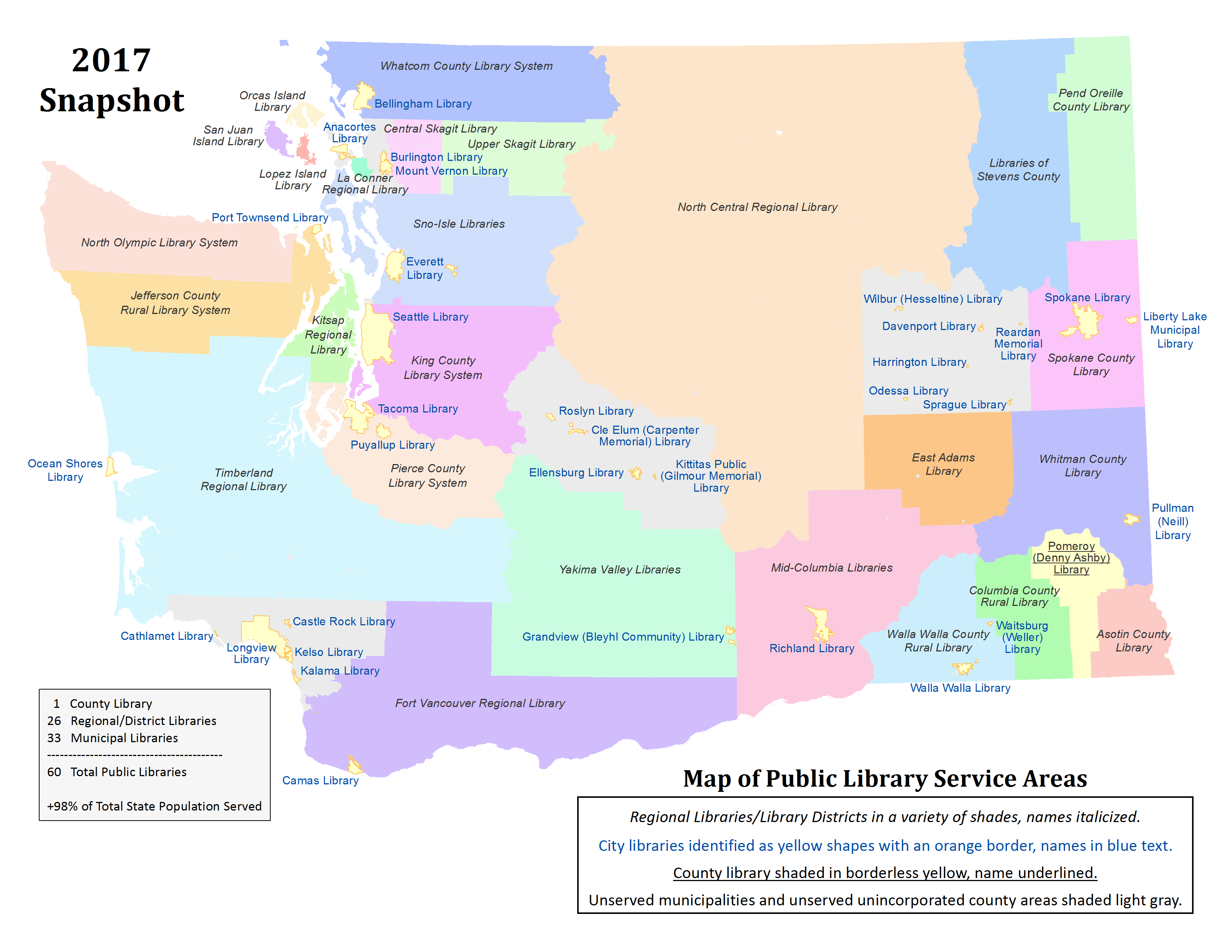
Libraries in Washington state also come in all sorts of bureaucratic structures (map), even if one only considers western Washington, and only public libraries.  However, they're easier to sort out if one considers how libraries are funded.  Some Washington municipalities have municipal libraries, which are departments of the municipal government funded at least partly from the municipality's budget.  In contrast, many rural areas in Washington belong to "rural library districts", which are primarily funded through their own property tax levies on district properties.  Many such rural library districts also include municipalities that have chosen "accession" to the districts, but municipalities in Washington with over 300,000 residents aren't allowed to accede.  That means, currently, that Seattle can't, but hope springs eternal for everyone else.  (When accession was first implemented in 1977, no municipality with more than 8,500 people was allowed to accede.  That quickly became a quite obvious problem, so in 1981 it was raised to 100,000.  In 2009, probably spurred by talks between the Renton Public Library and King County Library System which resulted in Renton acceding in 2010, the limit was raised, unanimously believe it or not, to 300,000.  I'm guessing that if Seattle really wanted to join KCLS, and, um, KCLS really wanted Seattle, a way would be found.)

Let's take this by county.  Of Washington's thirty-nine counties, nineteen are west of the Cascades.  Five of those counties - Thurston, Lewis, Grays Harbor, Mason and Pacific - have public libraries only as branches of a single giant library system produced by mergers of several rural library districts and accession of a bunch of municipal libraries, the Timberland Regional Library.  In contrast, two - Skagit and San Juan - are divided among multiple local libraries (in each case both municipal and district); Wahkiakum County has just one municipal library; and Cowlitz County has four municipal libraries plus a couple of outposts of the second-most-extensive western Washington "rural" library system, the Fort Vancouver Regional Library (also in Skamania County, Klickitat County on the other side of the Cascades, and most of Clark County).

One weird structure in Washington is quite common in western Washington.  The four most populous counties in the state - King, Pierce, Snohomish and, in eastern Washington, Spokane - all have this structure, as do two western Washington counties that, um, are considerably less populous, Whatcom and Jefferson.  In this structure, the largest city and county seat (Seattle, Tacoma, Everett, Spokane, Bellingham, and, I kid you not, Port Townsend) has its own municipal library or library system, and the rest of the county has a separate "rural" library district (the King County Library System, the Pierce County Library System, the Sno-Isles Libraries which also cover Island County, the Spokane County Library District, the Whatcom County Library System, and the Jefferson County Library).  Until Seattle annexed the land from 85th to 145th Streets in 1954, there were two KCLS libraries in that area, the Lake City Library and one called the North End Library, now replaced by SPL's Lake City and Broadview branches.  In Pierce County, not just Tacoma, but also Puyallup has a municipal, rather than PCLS, library.  Finally, Kitsap and Clallam counties have unified county-wide rural library districts.

(Yes, really, that's 19.  Look:

  • Clallam County - North Olympic Library System
  • Clark County - Fort Vancouver Regional Library, Camas Public Library
  • Cowlitz County - Fort Vancouver Regional Library, Castle Rock Public Library, Kalama Public Library, Kelso Public Library, Longview Public Library
  • Grays Harbor County - Timberland Regional Library
  • Island County - Sno-Isle Libraries
  • Jefferson County - Jefferson County Library, Port Townsend Public Library
  • King County - King County Library System, Seattle Public Library
  • Kitsap County - Kitsap Regional Library
  • Lewis County - Timberland Regional Library
  • Mason County - Timberland Regional Library
  • Pacific County - Timberland Regional Library
  • Pierce County - Pierce County Library System, Puyallup Public Library, Tacoma Public Library
  • San Juan County - Lopez Island Library, Orcas Island Library, San Juan Island Library
  • Skagit County - Anacortes Public Library, Burlington Public Library, Central Skagit Library District, La Conner Regional Library, Mount Vernon City Library, Upper Skagit Library District
  • Skamania County - Fort Vancouver Regional Library
  • Snohomish County - Sno-Isle Libraries, Everett Public Library
  • Thurston County - Timberland Regional Library
  • Wahkiakum County - Cathlamet Public Library
  • Whatcom County - Whatcom County Library System, Bellingham Public Library

See?)

Most more or less county-wide library systems omit specific municipalities that have opted out of paying for any public library, presumably because their residents are too poor to pay the relevant taxes.  In King County those are Yarrow Point and Hunts Point.  No, dear Diary, I haven't researched ways to alleviate the poverty of these areas.

Billions and billions of library cards

The main reason these bureaucratic structures matter to the average library user is library cards.  Parks only distinguish between those who support them and those who don't in cases which involve contact with parks department staffers, most obviously when scheduling events in parks.  While that isn't trivial, still, one can walk through, cycle in, photograph, play pick-up games in, a park wherever one happens to be.  (I sat on a bench to eat in a City of University Place park a few days ago.)  But in libraries, usually, without a library card one can't borrow materials, can't use the computers, can't use online resources...  On my first visit to a Timberland Regional Library library, while I was homeless, I ended up paying to photocopy the (short) book I'd come to see.  Of course, since that library was at the end of a very, very long bus trip, I also used a restroom and a water fountain, which no library I've encountered requires a card for (though some non-public libraries require cards to enter the building at all).  But despite the main focus of your pages, dear Diary, man does not live on water alone.  And anyway, this page isn't primarily about borrowing materials, but about hours, which determine when those restrooms and water fountains are accessible.  But in the meantime let's get back to library cards; I do have a reason for that.

Service area cards

Librarians in general have a strong bias towards being of service, and part of that bias is so common in Washington that I suspect it has a basis in law.  Many public libraries around here explicitly say something like this:  "If you do not live in Seattle, but work, go to school or own property in our free service area, we will ask you to provide proof of employment, student enrollment or taxpayer status."  (From this page.  Just about everyone offers cards to property owners; both library districts and municipalities are largely supported by property taxes, after all.  Cards for employees and for students aren't universal, but are each fairly common.)  It isn't very hard, therefore, for someone in Washington to be legally entitled to more than one public library card.

Reciprocal borrowing agreements

But it also isn't very easy, so libraries have another tool for scattering library cards hither and yon, called the reciprocal borrowing agreement:  Library A agrees to give people from Library B's service area their own Library A cards too, and vice versa.  There's remarkably little talk online about the benefits and costs, or pros and cons, of reciprocal borrowing agreements; one of the most detailed discussions I found happens to concern negotiations between the Tacoma Public Library (TPL) and PCLS.  (Even at Google Scholar, most of what I find concerns university libraries; given my own interests, it's ironic that I can't read two articles that are about public libraries because they're in Korean.)  That said, the SPL-KCLS relationship has repeatedly been contentious - in the 1970s (not paywalled) and again in the 2000s (both paywalled); I think also in the 2010s, but the only evidence I've found is this:  "effective June 1, 2015, Seattle residents with a King County Library System card can borrow and place holds on items in the collection" (from this page), implying that as of May 31, 2015, some other situation obtained.  (My unreliable memory claims that between 2006 and 2015 Seattle residents weren't allowed to place holds, and in the 2015 negotiation SPL demanded that that change, so it came down to the wire.  We're still allowed fewer holds than most other card holders.)  The biggest issue is usually money:  by and large, in these agreements, one partner lends more than the other partner, or provides more services of other kinds, and wants to be paid for it, but the other partner may consider the amount requested too much.

As that holds story suggests, reciprocal borrowing agreements can come with conditions, but by and large, reciprocal card holders end up with very similar privileges to service area card holders.  The most important exception is that no library familiar to me will do inter-library loan for reciprocal card holders.

Libraries negotiate these agreements strategically, and probably the biggest issue in their strategies is the negotiation itself; each such negotiation takes time and hence money.  SPL's list of eight reciprocal borrowing agreements is much shorter than KCLS's list, which lists not only libraries but also counties, many from Eastern Washington.  So the actual differences in terms of library systems are fewer, just three:  the Fort Vancouver Regional Library, the North Olympic Library System, and the North Central Washington Libraries (Grant, Chelan, Douglas, Okanogan, and Ferry, most of KCLS's actual list of eastern Washington counties).  Neither library deals with the six libraries of Skagit County, for example.  KCLS is nearly catholic with regard to library systems in western Washington, but as for individual libraries, only deals with Jefferson County Library (a single building in Port Hadlock plus a bookmobile), Port Townsend and Puyallup, with which last SPL also has an agreement.  (In other words:  SPL has deals with seven systems and one individual library; KCLS has deals with ten systems and three individual libraries.  Maybe KCLS lists counties in order to avoid an unlucky thirteen list.)

In general, for the libraries I've looked at, what a librarian at Library A wants to see is evidence of the applicant's address in Library B's service area, not a library card from Library B.  (Some also want to see Library B's card, but still want address verification.)  As a result, one can't chain reciprocal cards; for example, I can't go to Vancouver, Washington and demand a Fort Vancouver Regional Library card on the strength of my KCLS card.

Unilateral borrowing offers

Many libraries seem to offer library cards to anyone in Washington who doesn't live in a no-libraries area like Hunts Point or Yarrow Point.  (More exact quotations under the relevant libraries.)  This amounts to unilateral disarmament in the reciprocal borrowing agreement arena - these libraries lend to other libraries' users without any assurance of the flip side - but most libraries that follow this policy also negotiate some reciprocal agreements, which probably cover most of their lending, anyway.  I have no idea what happens, money-wise, when one of these libraries lends to someone who isn't covered by a reciprocal agreement - whether they just eat the cost, or the borrower's home library gets a surprise bill, or for that matter both.

Cards for money

Many of the libraries listed below also offer cards for people who don't qualify in any other way.  Notably, some libraries say explicitly that this is the only way for those miserable residents of Hunts Point, etc. to get cards.  Such cards vary considerably in price; in most cases that price is for a year or six months, but a few libraries, including SPL, offer shorter-term cards for shorter-term visitors, or perhaps for people who are just looking for one thing that isn't at any nearer library.  I indicate which of three positions each library takes - cards for fees, no cards for fees, no information - and any unusual provisions, but usually don't provide links, since the information is on pages I've already linked to for other things, nor prices or terms.

Later in this page

I think SPL's list is quite long enough for comparative purposes, and anyway the hours of libraries I can personally borrow from are obviously more interesting to me.  Essentially, besides the public service function of making whatever readers you get, dear Diary, aware of all these ways to get library cards, I'm also using library card access to decide which libraries to compare SPL to.  So the next part of this page (a really long part) starts with SPL and goes on to the eight libraries it has reciprocal borrowing agreements with in order by how close to my house the nearest branch is as the crow flies.  The part after that covers six libraries (public, in western Washington) with which SPL doesn't have reciprocal agreements, but that might, depending on the phrasing of their requirements and what the librarians I meet decide, offer me cards anyway, and also has a list of links to the remaining public libraries in western Washington, with minimal notes.  And the part after that is conclusions and analysis.  Four parts before I get to the university and college libraries at all.

Besides checking their hours, I survey each library's reciprocal borrowing agreements (and note any that don't offer interlibrary loan, and what their position is on cards for fees), and note whatever I find and think relevant about that library's relationship with homeless people.  In general, this doesn't include libraries acting as homeless service providers.  Many of the libraries I've looked at do this to a greater or lesser extent, as any Google search of ' "[Library name]" "homeless" ' will show; I note exceptions.  Since none of the homeless-specific services offered by libraries I visited during my years of homelessness were actually proffered or even known to me during those years, I'm dubious that they matter to most other homeless library users.

Part II (SPL and its reciprocal borrowing agreement partners) should come today, but I'm not sure about Part III (other libraries in western Washington), dear Diary; maybe tomorrow.  Part IV (analysis) will probably take until Monday or later, the parts about academic libraries longer still.  Anyway, happy times until we meet again, dear Diary.


Friday, January 21, 2022

An Update to "A Sweep"

Dear Diary,

Well, I may have survived what indeed proved to be an infection with COVID-19 - if I had to guess, with the omicron variant.  In any event, I didn't work on any of your at-home pages, dear Diary, while sick, so still have them all to do.  But now that I've returned to work, I have an update for you on the rocks whose quiet retirement some of my former peers were so rude as to disrupt for the sake of something so trivial as shelter.

Yes, that's right, those rocks are now protected from human beings by a fence!  Isn't Seattle a wonderfully kind and compassionate city?

Unfortunately, the fence is only temporary, even by humans' standards, let alone rocks'.  So I'm not at all sure these rocks will be protected long term from those so wicked as to want protection from the weather.

All for now, dear Diary.  I hope soon, though, finally to tell you about Lezlie Lowe's book No Place to Go.  Until then, a good night and good days.

Monday, January 10, 2022

Delay

Dear Diary,

I must apologise.  I didn't hike for you during this past weekend, which was apparently blessed with beautiful weather.

For much of last week, I waited for "Away from the Manger", which was the argument the previous two (or four) pages were meant to support, to get read by what I thought enough people before going on.  I thought I was making a fairly important point, and set pretty modest bars which it still took until Friday the 7th to meet, before I would send that page any further from the limelight than it already was.  I don't know how many of your readers, dear Diary, read you for photos of parks, but you and I know that you're about more than that.

Unfortunately, on Friday the 7th I missed work for the first time since becoming housed, because work has fairly strict standards for illness, and I was coming down with what I still hope is a cold.  But to make matters still better, on Sunday I learnt that I've also definitely been exposed to COVID-19 recently.  On the whole, I expect to miss work Monday too, or I wouldn't be writing in you this late.  I found it necessary, despite relatively balmy weather tonight, to wear the heavy coat I'm grateful for just to go get groceries.

The contrast between my situation and a front page story Sunday is intentional, but not fictional.  I really do have a cold, if not worse, and a woman had much worse while still living on the streets.

I still have a couple of things I can work on at home for you, dear Diary, as I recover, and navigate what the pandemic demands of these circumstances.  What I worked on during what I hope was the sleepiest phase was a spreadsheet of my favourite music from Korean TV dramas, which I'd put aside in July because I'd reached the time-consuming part of the job.  Well, it took three tired days, but that part's done.  Since this spreadsheet includes YouTube references, it'll probably go out of date pretty quickly, quicker than I can hope to build my planned K-drama blog, so I'll put the spreadsheet into my Google Drive and make it public once it's caught up (sometime in February, according to my current plans).  Meanwhile, I hope I'll be awake enough tomorrow, and any other days I might miss, to work on the at-home tasks for you, dear Diary, and it looks like next weekend might also be dry enough to hike.  Until then, good nights and good days.