Showing posts with label privacy. Show all posts

Saturday, August 1, 2026

Under Construction, part II: Themes

Dear Diary,

Well, I've been hiking, and have now visited six of the thirteen parks on my list for this page.  But technical problems are slowing me down, and anyway I can probably make the remaining parts shorter by putting these general remarks into one place.

Because, you see, dear Diary, Seattle's Department of Parks and Recreation has certain priorities when it comes to construction.  Let's start with a couple of magic words.

Activation

Parks cares a lot about how many people use its parks, and the particular feedback loop it embraces is known as "activation".

The idea behind activation is that there's always room for one more person in a park, and to the extent their budgets allow, park managers want to bring that one more person in, using techniques known to help in doing so.  I'm not sure believers in activation think there can ever be too much of it.

Now, I have a pretty jaundiced take on this whole activation ideology, because I'm not at all sure weird single middle-aged men are in activation's target audience, but I'm absolutely sure homeless people are not in activation's target audience.  In fact, activation is often presented as a way to discourage homeless people from being in parks, by outnumbering them with normal people.

Nevertheless, Seattle Parks embraces activation ideology, and it comes up time and again in their construction projects.  Specifically, they like to replace playground equipment, partly as trends in safety engineering change (and perhaps advance), but also because new equipment is a new chance to activate more kids.

Access

I'm not here, dear Diary, to object to the Americans with Disabilities Act of 1990, from which we all benefit in many ways, and from which I, personally, benefit in specific ways as well.

But already in my hiking, I've become convinced that the word "access", used in explaining park projects, has a weird meaning, at once narrower than it should be (a path can be made "more accessible" without removing stairs) and broader than it should be (any path can be made "more accessible" by widening it).  So, in Seattle Parks project management, "access" is a magic word, not a well thought out principle.

Synthetic turf

Not all park construction norms are magic words.  Seattle Parks has been fairly busy replacing natural playfield surfaces with synthetic ones.

Not being an athlete, I have no real opinion on synthetic turf as an experience.  It may well be less "ecological", but I've already visited one target for conversion, and no blade of grass will be harmed by the planned changes to Woodland Park's Field 4's infield:

As an accounting student, though, I have to admit that synthetic turf is a major bureaucratic win.  Instead of considerable expenses to mow, water, and so on - labor expenses, mostly, very high in Seattle - synthetic turf is an asset, and depreciates.  Replacing it is small change in capital budgets.  I don't know, though, whether it's also a win for taxpayers.

Single user stalls

Yes, dear Diary, Seattle Parks also has a norm concerning your core topic.  (Although both access and activation will come up in that regard as well.)

I think it's obvious that single user stalls aren't as efficient in using space as multi-stall restrooms.  Each single user stall has a sink, after all, and probably a dryer.  But I don't have proof, because I hardly ever know how big the women's rooms are, so I can't do before and after comparisons.

For example, the old Cal Anderson Park men's room had two stalls plus a urinal.  Did the women's room have two or three?  Impressively, Parks managed to squeeze four single user stalls into that building, which is either parity (ignoring for now the urinal) or minus one.  However, two of those four were damaged years ago, and aren't on the construction radar, so it's worse than that in practice.

Single user stalls are certainly safer, while people are in them, and that's not trivial - someone running away from someone else can take pretty good refuge in one.

Well, dear Diary, those are the things I wanted to sum up here.  The time I've spent hiking has been available because my instructor has given us some days to study before the midterm on Monday.  I hope to visit three more parks tomorrow, but that still leaves three in Lake City, plus Hubbard Homestead and a return trip to Woodland, to squeeze into several weeks of frenetic assignments thereafter.

As for when I'll tell you about these hikes, dear Diary, it's more of a hassle than it'd been the past few years, but less time-consuming than hiking, so I hope pretty soon.  Until then, happy days and nights. 

Tuesday, December 15, 2020

The End of the Tour

Dear Diary,

How have you been?  I see you've had a lot of visitors the last day or two.  I hope they were all wearing masks.  I was busy doing something I thought I had to finish in one big heave, but I'm sorry I neglected you for so long, especially since I'm still telling you about my hikes in mid-October.

At least this page should finish one of the hikes.  The previous page, "To the Beaches!" all of two weeks ago, left me trying to sleep at View Ridge Playfield's picnic shelter the night of October 12.  I woke there October 13, verified that the water fountain still wasn't running, and continued north to 75th St, getting food at the Safeway at 35th Ave.  Continuing along 75th, I stopped at 30th to take a photo of Maple Leaf hill:


Well, at least that's what I was trying to show.

My destination, way over at 25th Ave, was

Dahl Playfield

I wanted to do three things:
  • verify that the water fountain still wasn't running (it wasn't)
  • take a photo
  • and take a video.
The photo had to do with a mistake I'd repeatedly made.  I've visited this park just enough to have picked out a preferred spot in it, one of a pair of picnic tables near the path from the park entrance to the restrooms.  Just south of those tables, a thin screen of ?saplings separates the tables from what, in the summer, had looked like a child-sized trail, and I'd thought, "how remarkably thoughtful!"

When I visited earlier in October to begin my water fountain census, of course I found out that this was actually a creek bed, dry in summer but, well, not in fall.

Finally the video.  When I came here on June 27 I think I took one, but then deleted it.  This time I didn't even take it.  But my past failures to describe correctly what makes the men's room at Dahl Playfield uniquely non-private, even compared to other restrooms without stall doors, weighed on me, and some time later I shot this one.  I'll try to embed it, but since I flagged this one as age-restricted from getgo, and my embedded videos aren't working properly, I don't have much hope where this one is concerned.


Anyway.  There's a reason I've visited Dahl Playfield so often.  See, it's right across the street from the last of the "last seven" parks, as I then thought they were, that I visited on June 27:

Picardo Farm

Have you ever wondered what the "P" in "P-Patch", the name in Seattle for community garden spots, means?

Around the middle of the 20th century, there were still farms in the Ravenna neighbourhood, but by the 1960s only one was left, and it was on its last legs.  Neighbourhood activists worked out a deal by which the city bought the farm, and parceled it out into individual garden spaces.  When people in other areas demanded their own places, the name of the farm's family - Picardo - got attached.  Hence P-Patch.


I mentioned re Maple Leaf Community Garden (in "Six Parks in Search of Another") that most P-Patches are assigned by the city to the Department of Neighborhoods, which runs the program in all of them, and that when a P-Patch was instead accounted to the Department of Parks and Recreation, it was worth asking why.  In this case, I think it's inertia.  I don't know that the DoN even existed when the city bought Picardo Farm; it certainly didn't get the property, which has, I assume, been treated as belonging to Parks ever since.

One of the many distinctive things about Picardo Farm is its size:


Another is its plumbing.  It doesn't have a water fountain, but oh mama, does it ever have a sink:

Near the sink is the sign explaining the history I probably butchered above:

Continuing east to the northeast corner, we reach ... well, not plumbing, not exactly, but a restroom nonetheless:


If you Google "Picardo Farm", one of the first things you hear about - one of the main things they brag about - is their "composting toilet", shown above.  I didn't find it in June, but whenever I did, it was ringed with signs admonishing visitors to use sanitiser, which was offered on a nearby table.  Now, I would think that a good idea regardless of the pandemic, but when I returned in mid-October the table, sanitiser, and, I think, some of the signs were gone.

Did I mention that Picardo Farm is big?  Three acres, not large for a park, but huge for a P-Patch.  Not that parks that size normally get plumbing or restrooms, either.  So of course Picardo Farm also has a picnic shelter:

Well, enough.  Picardo Farm really is a P-Patch, which means the rules governing visitors from the general public differ from those applicable in parks; in particular, the hours are shorter.  (Which is one reason why I didn't yell and scream about the restroom earlier; Dahl Playfield, even with less privacy, has a sink and longer hours, and is clearly preferable.)  Visitors should read and heed those rules.

Roosevelt Land-Banked Site

When I looked up the address, 1321 66th St, I was sure the parks department had made yet another deal for, well, this:

But it's only a fifth of an acre, which even I know is too small for a football field, and the address turns out to be across the street:

I don't know whether the department plans to put a park there after the construction office closes, or to trade the land for some other parcel, but anyway, my Rand McNally maps are still wrong about Roosevelt High School being park land.

I headed from there toward Wallingford, for reasons I'll get to soon, but stopped along the way to visit

Froula Playground

Like Bitter Lake Reservoir Open Space, this park is built next to a reservoir, but offers not a drop to drink, so I tend not to pay it much mind, but thought I should make up for saying virtually nothing about a place so close to the UW - 12th Ave and 72nd St - by taking a picture:

Note the concrete seat in the foreground.  This place just keeps finding new ways to disappoint me.

There are two parks department parks left that I haven't told you, dear Diary, about yet, even though both are in "NE".  I reached one on October 14, the other October 20.  I wanted to finish the job in this page, but to start and then run up against Blogspot limits would be worse than just starting a new page from getgo, so I'll stop here for now.  Until the next page, dear Diary.


Wednesday, July 1, 2020

The Ballard Seacoast: Parks Not Parks', part II

Dear Diary,

Golden Gardens Park

is over three hundred feet tall.  It is just under 100 acres in area and about 100 yards in height.

I didn't know that on the evening of June 23 as I tried to thread my way through the crowds to explore the part of the park in which I found myself.  I took a picture pretty soon, as the park slowly revealed the reason for the crowds:
There are, of course, restrooms at the beach, off to the north end, but I never got a very good look at them - crowds again, but also sand, which for some reason disagrees with my cart's wheels.  I think there are two stalls in the men's room, and no dryers; what I'm sure of is lockable doors.  I found a water fountain near these restrooms and one at the south end of the beach, neither running.

Also, the man I'd met at Salmon Bay Natural Area had told me of showers there.  Next to the men's room entrance there are high and low spigots, right out there in the open, so a user is expected to keep on a bathing suit or equivalent clothing, and of course neither soap nor towels are provided.  There's enough sand on the walkways there to make these showers finitely useful for their intended purpose, but both times I visited there was enough water under them to show they'd had some use.

North of the restrooms, the beach gives way to more usual park stuff - a playground, some sports space, then a protected wetland and, furthest north, another beach.  That night, however, my attention was caught by a sign introducing the park:
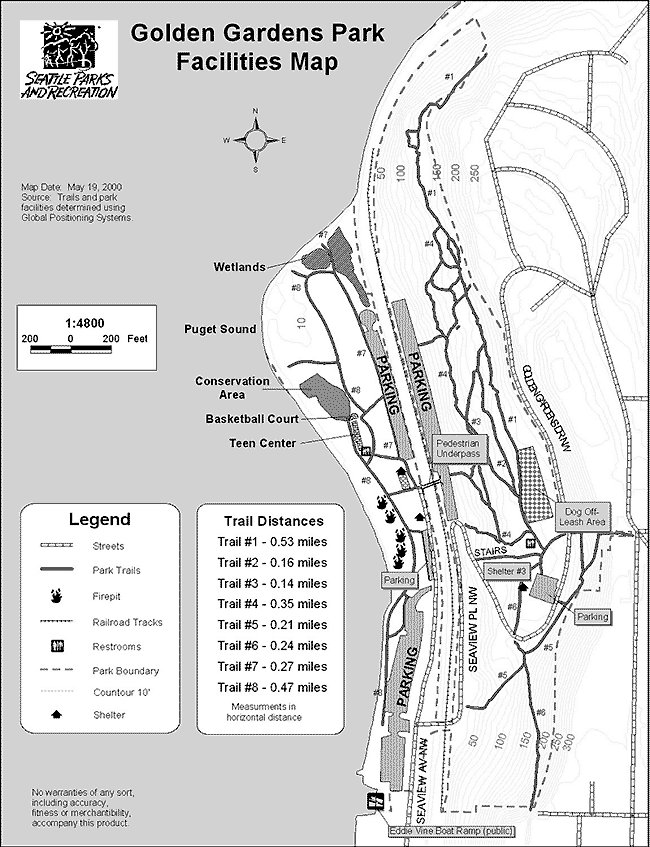
It says the yellow sand is all home-grown, which certainly isn't true of the Midwestern beaches of my childhood.  It also has a map, which made me just a bit more confident than I should have been.
See, this sign, and this map, don't mention that Golden Gardens Park is 300 feet tall.

So, confident I'd explored enough, I looked for the beginning of a barrier-free trail up to the rest of Seattle.  And I didn't find one, and didn't find one, and ...  There is a pedestrian path to the next level, but I learned the next day that it's paved in poorly mortared bricks.

It was, of course, silly of me to expect such a path.  I mean, sure, there's a barrier-free path for cars.  But a similar path for people afoot, or using other kinds of wheels?  Why, that would amount to a, a sidewalk or something.  How could that possibly work?

(Of course, since then the road, which changes names from Seaview Ave to Golden Gardens Drive just within the park, has been closed to cars by the Stay Healthy program.  This is most obviously inconvenient to those who live on houseboats moored in Shilshole Bay Marina, but it also forces people driving to or from the beach into Seaview.)

Finally I gave up and did as the park's designers obviously intended me to, launching into the road.  Drivers adapted, though perhaps not happily.  It helped that I kept leaving the road to explore, during which exploration the traffic thinned.  It was pretty much night by the time I heaved my way up the last steep hill (I'm afraid that even with cars removed, somewhere close to the top some wheelchair users will probably struggle) and rejoined Seattle.

My priorities by that point were finding places to do Number One, and to sleep.  But the next morning, bright-eyed and bushy-tailed, I returned.  I was armed with this guidance from the Washington Trails Association (I intended to follow the routes suggested by Alan Gibbs) and with this map, probably originally parks department work.  I was going to walk every trail and really get to know the park.

But first I was going to wash my dishes.  At the top of the park I found a sort of out of the way place to park my cart, and went down many steps (Gibbs's counts are roundedly correct) to the park's other restroom, which I'll introduce shortly.  When finished, I had an ordinary plastic shopping bag containing my detergent, my hand soap, and some washed deli containers.

At this point I decided to go down yet more stairs and take the photos I just showed you, which means it was 11 A.M.  Having started my visit to the sea level part of the park at the sign this time, I went further north and for the first time saw the "North Beach Entrance".  I was curious what the wall at the end of the beach looked like, and proceeded...

Yes, I'll get to what happened next, but it takes us into other parks, so let me finish up with Golden Gardens first.  The stuff I found there can sort of be organised into four levels.  I've already described the sea level one.  The next one up isn't all that far up, and is mainly for overflow parking, but also has mysteriously abandoned streets and, uphill, the park's headquarters.  I don't think it has any entrances from outside the park.

Next is the level with an off-leash area for dogs' people.  There may be a water fountain in that, but I found none near the restrooms mentioned above.  The men's room has one stall with a lockable door, and, I vaguely remember, no dryer.  There's also picnic areas and parking on this level.  I don't think it has access to the streets either.  Finally, up top there's a bench, the head of a stairway, and a bus stop.  (There's no bus on Seaview.)

I did not end up taking every trail.  I took one trail without stairs, so they do exist, but there are many, many stairs on trails in Golden Gardens Park.  The reassurance on that map can only have been meant for the area the map shows, the main beach.

So to return, there I was, setting out to find the wall of the North Beach.  I didn't.  The beach got stonier, and less and less crowded, and at some unposted point I crossed over into

(?) North Beach sensu stricto

For a long time, it seemed, it was just me, the sand, the stones, and the sea.  I started thinking Edward Abbey (whom I haven't read, but some of whose books I once owned) would be at home here.  I felt that taking photos would breach the sacredness, so sorry, you're going to have to make do with words.

Eventually I reached an entrance.  All I knew then was that the street system was on the other side, and the door was locked.  Cursing the city's uneven closures, I walked on.  Not too much later I must have crossed into

(?) Blue Ridge Beach

because I reached that entrance.  Beyond which lay a park not Parks'.  Also locked.

From there I could see other stairs, so I decided to stay on the railroad embankment that lies between the beach and the rest of Seattle.  I knew it was risky, but figured it was only for a short way.  Unfortunately, the stairs turned out to lead to private residences; I didn't even bother climbing them.

Well, here's the crucial decision:  I didn't turn back.  Not to the exit from the embankment at the Blue Ridge Beach Park entrance, and certainly not to Golden Gardens Park.  I was bound and determined to reach the northern wall of North Beach, and turning back would just delay that.

(?) Tidal mudflats

It turned out there weren't nearly as many accommodating rockfalls below the embankment as I'd hoped for.  Partly this is because I'm quite short and, let's say, not very friendly with heights, but also it seems human convenience is not a high priority for falling rocks.

So I stayed on the embankment, still, mind you, carrying that astonishingly durable plastic bag.  I found it harder and harder to keep my footing (my right shoe will probably never be the same) and forgot all about communing with dead naturalists, as the beach below changed in a mysterious and baleful way:  it gradually became ever more dominated by a shining black surface with brilliant green highlights.  I didn't know what it was, but even though I remained determined to escape the embankment, I began to be grateful I hadn't yet.

Carkeek Park

This is where I finally found a rockfall suited to small climbers.  I know this because, within a few feet of me, were venturesome beachgoers also struggling with what I assume is tidal mud.  (If you want to repeat this hike without risk from railways, wear or at least carry high boots.)

After escaping various beach hazards and climbing the stairs, I did at least Number One in the men's room there, found the water fountain not running, and headed for the exit.  Carkeek Park Drive turned out to be much like Golden Gardens Drive - uphill, twisty, and sidewalk-deficient - but there was much less traffic, and I'm quite sure I took less than a month to reach the street grid again.

From there it was a simple matter to head back to Golden Gardens - though I admit I took a bus partway, worried about my cart, which proved untouched.

Later that day I got some answers.

REDUX:  (Private) North Beach sensu stricto

The streetside entrance to North Beach - the first I'd encountered - is at 28th Ave and Esplanade St.  The sign on the door there also hangs on the fence around a building adjacent to the steps, so I'd assumed the rules that sign outlines of the "North Beach Club" applied to the building.  Nope:  they apply to the door.

The website the sign points to explains everything.  Back around 1930 the purchasers of a bunch of new homes in the area organised to take care of water service.  The developer did it for them, and also handed them the relevant stretch of beach.  They now have two levels of membership.  Residents of the original 90 houses are full members.  Residents of a surrounding area can apply for associate membership.  One element of membership is a key to that door.

My apologies to the city for blaming it.

REDUX:  (Private?) Blue Ridge Beach

Blue Ridge Beach Park, the park I saw through the second locked gate, is a membership park at Neptune Place and Blue Ridge Drive.  I think it's very likely run along lines similar to those of the North Beach Club, but unlike the latter, the Blue Ridge folks seem to say nothing online; if there's a URL in the part of their sign
hidden by later accretions, it doesn't come up in any search I've tried.  Note also a nearby "Blue Ridge Park", also private.

On the 26th, I got back to, um, 

REDUX:  Carkeek Park

Piper's Creek Natural Area

Eddie McAbee Entrance

This park or set of parks or park and set of parks or ... has a map:
but that doesn't really clarify matters.  The entrance is definitely the southernmost bit, and by itself is an ordinary neighbourhood park with an ordinary non-running water fountain.  The park is listed in the real estate report as 172 acres, considerably fewer than the numbers (there are several) usually given.  The area is listed as only 9 acres, the entrance not separately listed.

I entered the second time through the entrance, grateful to avoid Carkeek Park Drive.  Down a steep hill on a graveled trail, I parked the cart and proceeded.  The trail features many deteriorating posts advertising a "story trail" whose text can be found various places, including online.  They date to 2004 and aren't online any more, not even at the Internet Archive.  Maybe a physical copy survives.

The trail is very long even after the "Story Trail" posts give out, and I got less grateful every step.  Much of Carkeek Park's area is spent on vast greenswards, which maybe get used at times other than those I was there.  I had to walk past all of them, both times.

The park's focus - playground, restrooms, etc. - is at the end of this trail, near the stairs to the beach.  The men's room has lockable doors, a working dryer, and as many toilets as both men's rooms at Golden Gardens put together, so I guess Carkeek Park must be very popular sometime or other.

Much space goes to trails, and I gladly climbed one heading north above the beach, hoping it would show me what becomes of the beach.  But in summer the leaves are too thick to see anything else.  Fundamentally, Carkeek Park has two levels, the beach and the rest, and they haven't much to do with each other.

So to find the north wall at last I'd have to walk there myself.  Actually, more like clamber; Carkeek Park's beach of golden sand is much smaller than the one at Golden Gardens, and just feet from the stairs it turned black and white (like the sand at the 57th Street End), then got stony.  I walked the stones a fair way, avoiding all bright black mud and brilliant green seaweed.  And there ahead of me, just as Google Maps had said, lay the wall.  The railroad embankment turned to meet the coast, cutting the beach off.

I'd put the detergent away on the 24th, but continued carrying trash in the valiant plastic bag until a label ripped it on the 29th.

Some last remarks

North Seattle's It Parks, the famous ones closing at 8 P.M., are often walled.  Not Green Lake or Woodland - except metaphorically, by the physical covering of the maps of the former, the lack of maps of the latter.  But at Gas Works you have to imperil your life in traffic to reach a paved entrance.  And at Magnuson, Golden Gardens and Carkeek you have to hike a long way - and perhaps take stairs - to arrive at the good stuff, in each case including but not limited to beaches.

Meteorologist Cliff Mass has argued that park closures, especially closure of parking lots, is class and ability discrimination.  You could add the closure of Golden Gardens Drive in support of his argument.

It's piffle anyway.  Seattle is a progressive city, no more capable of classism or ableism than of racism.  Next thing you know, someone will claim the President behaved badly.

So surely it's just coincidence that there are almost literal walls around much of the Ballard seacoast.  But you know what would really put paid to his argument?  A bus down Seaview Avenue.

All for now, dear Diary; I'm grateful not to have overshot midnight as badly as last time, but I can't continue at this pace.  The next few pages will cover:
1. Crown Hill ("NW")
2. Greenwood (mostly "N")
3. Blue Ridge ("NW", a very short page)
4. Top of the City, part III (mostly "N")
5. Obscure and incipient parks ("NE")
but although none should be anywhere near as long as these pages on the coast, I can't promise a schedule.

Sunday, June 28, 2020

A Lazy Day on Loyal Heights

Dear Diary,

The last page got well into the evening of Monday, June 22, but I wasn't quite done.  There was one more place left named for Ballard.  And it was becoming clear that bus shelters would be terrible places to sleep on weeknights - in Ballard (and "NW" generally) they only seem to build shelters for routes that run 5 A.M. to 1 A.M.  So I needed to do as my peers do and sleep in parks, and Gemenskap Park was hardly a good choice for that.

So I crossed 65th and went on to the third set of parks.

Ballard Pool

Yes, all the pools are closed due to the pandemic, but that doesn't mean I should ignore them.  What if one had outdoor restrooms, like some community centres?

But Ballard Pool is even closeder than the others.  Turns out there was a general update to all the pools last year, and Ballard Pool drew the short straw for unexpected problems, pushing it into the coronavirus shutdown.

And no, not that I could see that well through the fences and whatnot, but it doesn't seem to have external restrooms (or water fountains) either.  It's on the Ballard High School grounds, on 67th St just east of 15th Ave, if you want to look for yourself.

Off to 9th Ave and 70th for

Kirke Park

This is a medium-small (just under an acre) park whose historical focus is even odder than Ballard Corners's thing about five-and-dimes.  Turns out it's on land that used to belong to a cult, only since this was long ago it was called a church instead.  They were into long hair and vegetarianism, but unlike the hippies, also celibacy, and like most celibate cults died out in the end.  The Seattle Department of Parks and Recreation website says the things I liked best, the ridiculously perfect ruins decorating the area where park gardens shade into the P-Patch, really are the ruins of the cult's buildings.  Some pictures:


Before taking those, I slept in a park for the first time since I was newly homeless, back in 2012.  Which reminds me:  In general, I did not see my peers in the parks north of 65th described in this page.  I may well have been the only person sleeping in Kirke Park that night.  I felt relatively safe doing so; the park has unusually many trees shading it.

6th Ave NW Pocket Park

This tiny park is all playground in my memory, though the department website says (and shows, with photos) there's also a lot of grass.  The website and I prefer the same aspect of the park - its architecture - but they like its details, while I just thought it hung together beautifully.  That said, they have a version of the same shot I took to demonstrate:
Next a long hike, across 80th St I think, to

Loyal Heights Playfield and Community Center

Having lived eight years on "Capitol" Hill, I have a certain fondness for, shall we say, aspirational neighbourhood names, and I amused myself this day imagining a Disloyal Valley, or Mountain, somewhere else.  Alas, turns out the area was named for the developer's daughter, and he probably didn't name another the opposite.

Anyway, as already mentioned, the Community Center here has restrooms built in with external doors, similarly to the Ballard and Laurelhurst ones (the ones at Green Lake and Magnuson differ more).  Neither Ballard nor Loyal Heights takes advantage of this setup to offer hot water as Laurelhurst does, however.  The restrooms at Loyal Heights do have lockable doors, but lack dryers.  Now, it occurred to me that because I once wrongly said Ravenna Park's upper restrooms lacked dryers, you, dear Diary, might not believe me about all these "NW" parks' restrooms, so I took a video to try to show you:

Like many parks, the playfield here is on two levels.  The upper one has the main community centre doors, a box painted blue with "Police Box" written on it but actually holding a free library, a playground, and a water fountain near that last, not running.  The lower part has the baseball diamonds and the restrooms, with a water fountain near each, not running.

From there it was just a couple of blocks south on 20th Ave to 

Salmon Bay Park

where I arrived around 8 A.M. to find the restrooms closed.  I called at 8:13 to find out whether they were supposed to be, and despite some confusion occasioned by the park's name (it's nowhere near Salmon Bay) eventually learned that the doors should be open.  So I found a shaded bench, and waited.

This was not the quick service I'd seen at Northacres Park.  Someone arrived at 9:24, opened the men's room, and started cleaning it.  Presumably they then repeated this at the women's room, but I'd already used the restrooms at the Community Center, I'd eaten calories for breakfast, and it must have been pretty close to then that I fell asleep.

This is why I had to correct my mistake about my shopping on the 22nd.  See, I started this trip on the 21st with most of a box of my usual weekend cream cookies, a day behind schedule.  So I had no business buying calories on Monday the 22nd.  But when I walked into the Safeway near downtown Ballard that day, I saw ads for a sale on their house brand of ice cream.  They used to sell a few flavours in this brand really cheaply, and for the first few years of my homelessness I bought one carton per summer, to give myself lazy days.  Then they got fancier with their house brand, more than doubling the price, so I've only had ice cream since then if I got to a Fred Meyer in the summer.  But this sale was for the old price.  So I bought a flavour they'd never offered at that price, close to my favourite, but as it turned out not close enough, and I didn't finish the carton.  Anyway, for some reason the lazy day was offset by one.

So I slept there on nothing but cream cookies, well past the bench's becoming sunny, waking around noon.  Of course I needed the restroom again, and of course it offered neither a dryer nor privacy, so I took a picture:
I'd already taken pictures of neat stuff.  The neatest thing about Salmon Bay Park is its rolling landscape, on which practically all the paths are paved.  This photo probably doesn't do it justice:
I also liked some tiles in the playground, although as I traveled on I kept seeing the same ones, which somewhat dampened the liking:
Finally I set off down 70th St towards

Webster Park

This small park is on 68th St near, but east of, 32nd Ave.  I'm pretty sure this is the park I vaguely remember only being able to approach from the west (i.e. 32nd) thanks to construction.  It's dominated by a playground, but I do remember it having grass, benches, etc., and resting for a time there.  EDIT JULY 3:  It has a water fountain too, which was running that day, but only in a trickle.

All the art is carefully separated from the playground so as to not to endanger the kids with it; it consists of a sundial by Chuck Nafziger and a set of four bas-reliefs by Charles S. Bigger called "Crossings", three side by side with words I couldn't read apparently telling a connected story.  Scrunched together as they are, they rather get in the way of photography, but here are my best tries:


Next north on 32nd to

Sunset Hill Park

OK, so the parks department website shows benches, and I remember people lying on the grass, but I still think this park at the edge of the cliff on 34th Ave between 75th and 77th Streets is all about its views.  It expresses this by putting a fence along the top of the cliff, and having its only trail run mostly alongside that fence.  I wasn't there at sunset but here's what I could do:
At this point I realised I couldn't get to my next destination from where I was.  I needed to go back south, and find a path to tomorrow's topic, dear Diary, the Ballard seacoast.

Sunday, June 21, 2020

Past Work and Gas Works

Dear Diary,

I didn't get far today - barely dipped a toe into "NW" - but have enough pictures that it seemed best to update you tonight, before I forget what they all are.  That said, I didn't take pictures of Gas Works Park's copious neat stuff.  It was 2 to 1.   Yes, take pictures because it's the closest working restrooms to the southern U-District.  No, don't because it's outside my focus area.  And decisively, no, because there are already professional photographers making their livings off this extremely photogenic park, and I'm not interested in competing with them.

Anyway, we start somewhere much smaller:

Christie Park

When I last visited, I found two workmen who knew nothing of a water fountain in the new park.  Well, on a Sunday evening this time I sure didn't find any workmen, but, well, I found a water fountain:

No, I don't know whether, when the park opens, the fountain will be running.

The Burke-Gilman Trail

I didn't find any new plumbing here, just an example of the sort of tree covering that gave me the willies at first sight at Meridian Playground:
Imagine that farther, higher up, taller, and at night, then multiply by five.  That's what my phone's video camera couldn't capture.

Waterway 19

I'd forgotten what a life-threatening nuisance it is to enter Gas Works Park on a paved path as a pedestrian.  So after I'd taken care of an urgent need to do Number Two and yet again, sigh, an overdue need to do Number One, I looked for a paved path, without stairs, down to the picnic shelter.  The one I found is not all that paved - tree roots have turned it into a complex landscape - but anyway I figured I could start exploring by going north.  Which led me to signage I'd ignored the first time, for Waterway 19.

Thus informed, I walked the loop trail, and of course saw, um, running water, for some value of "running", but not plumbing:

Waterway 18

Emboldened by having figured out one Waterway, I sought the other.  It turned out to be pretty far - I'd say "blocks away" except that Northlake Way doesn't have blocks.  Pedestrian access is, of course, risky.  I still have no idea who owns it; here's the only sign:
And it more or less is a beach, nowhere near the pseudo-wilderness of 19:
It's about twice as wide as what that picture shows.

Gas Works Park

It turns out there's rather more paved walkways in this park than I'd thought, but it still quickly became clear why I've never really explored it before.  I did unbend enough to photograph the flock of geese whose Numbers Two were making my twilit navigation just a bit dangerous:
But my main purpose was to look for additional restrooms or water fountains, and of course I didn't find any.  I did, however, find this sign:
Now, I think it would be wonderful to have safer, more accessible ways to enter the park, and up to date restrooms (yes, the city of Seattle prefers a newer-fangled euphemism, "comfort station") - well, that would be great too.

But I don't think this was built in 2017:
Yep, doorless stalls.  Also, you probably can't see an absence, but there's no dryer.  The women's room's stalls face the entrance, so it's a good thing they have doors, as this timidly taken photo may not make clear:

I saw a woman waving her hands to dry them when I was doing the same, so presumably that room also lacks a dryer.

I have no idea where the money allocated to the project ended up.

So that's my report on Gas Works Park and some others, dear Diary.  Tomorrow, back to two Fremont parks to tidy up more loose ends, and on to Ballard.

Friday, June 12, 2020

A Night View of View Ridge Playfield, and a Name

Dear Diary,

Last night, I kept at another project of mine way too late.  And then around 12:30 A.M. I suddenly needed to go do Number Two.  My options included Safeway, if I could get there enough before 1 A.M.; View Ridge Playfield; or Gas Works Park.  Since I was, as usual, in the northeast of the main campus, the easier direction by far was east, towards Safeway and then, since I got there at 12:57, View Ridge.  Fearing all the while that I'd been misinformed, last week, and the playfield's restrooms wouldn't really be open.

I needn't have feared.  (More precisely, I needn't have feared that.  I should've feared the cliffs in nearby sidewalks more.)  Yes, dear Diary, it's the return of the dreaded door shot:
I remembered that in the page in which I'd forgotten View Ridge's restrooms, I'd been paying attention to privacy.  View Ridge's men's room is in the common category of not-quite-worst:  the toilet stall has no door, but does face a wall at the far end of the room from the main door.  In this particular case, you can see that there used to be doors; I have no idea why two of them:
One aspect of the playfield had puzzled me on both previous visits, because it involves stairs.  Since the park was deserted, it seemed a good time to walk away from my cart and climb those stairs.  Now, all I've seen people do at the top of the stairs is turn around to look at the view, which doesn't work at all well at night, but here is, as promised, a night view of the playfield:

There turned out, though, to be an open door at the top, and I couldn't resist going through it.  There I gradually found what seemed a whole new park:  a ballfield, a playground, picnic tables ... ?  Finally came View Ridge Elementary School, and light dawned.  The neat stuff I found there, a mosaic near the picnic tables, is almost certainly on the school side of the border, but here's a picture anyway:


One of the few who've been reading you, dear Diary, in the slow time that I hope will end soon, asked me a question the other day.  He wanted to know what I thought of the current protests.  I replied, essentially, that they've become too big to have a single opinion of.  I can't forget, for example, that I shop daily at a store that was attacked under cover of a protest.

But that evades a central aspect of the question.  I have continued to write you, dear Diary, instead of running off to join the rallies, so I suppose it's only fair that I be asked, but my answer is unambiguous:  Black lives matter, and should not be taken at anything like the current horrendous pace by those who claim to protect and serve us.

Several of my first publications were about race relations in Chicago.  My work on a student newspaper there is almost my only published writing not available online, but if you watch this page, currently pretty much up to 1984, eventually you should find:  "A Study in Black and White", early 1989, history; a story about crime in spring 1990; and two items in September 1990, "Analyze Don't Memorize:  There Will Be a Test", chronology, and "Segregation", maps.

So here's the last thing that got my attention in View Ridge Playfield last night:

And here's a display in front of University Unitarian Church, not far away, that names some names:

I want to try to return to the conversation a name that hasn't been said nearly enough, these last weeks.  In my first publication in Seattle, I made the following extravagant claim:  "as a mentally ill homeless man, I give thanks daily that I haven't found myself in law enforcement's gunsights."

Extravagant, but mostly true to this day; and if I don't fear police as much as might a black man in my shoes, I still do fear them.  That's due to several attacks on people like me, but especially the murder of John T. Williams, 1960-2010, in my old neighbourhood.

Williams was, like me, not black, but unlike me he wasn't white either.  He grew up in a First Nations village on Vancouver Island.  He became a carver, as is often said, but rather less often have we been shown his work; here's an example from the 1980s.  We hear that he also grew up alcoholic, and he was living at 1811 Eastlake, not technically homeless, when shot; but he was also, apparently, separately, mentally ill.  He was known to the policeman who shot him.

Apparently there was some saying of indigenous names on Capitol Hill lately, so by rights he should already be known to many protesters; but it was time anyway for me to say his name.

Bye for now, dear Diary.  I'm currently planning a very long trip to take in all the remaining North Seattle parks known to me, to begin next week if the weather actually does improve, as forecast.