Monday, November 8, 2021

Cities for Energy Beings

Dear Diary,

Yes, I know, I keep telling you it'll be days, and I keep lying.  Sorry, but not really.

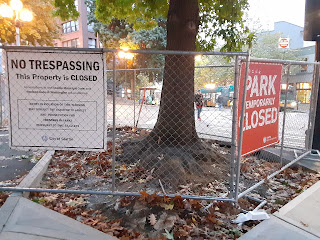
Tonight I went to 15th & John on Capitol Hill.  When I was housed there, the dry cleaners near that corner were my preferred spot to get alterations made because I'm so very short.  They close early these days, so I'll have to find another place, but anyway, while I was there I saw that Williams Place, the tiny park between that cleaning shop and the Safeway at that corner, was fenced in with orange netting.

I can't find any record of a sweep at Williams Place more recent than this summer.  So perhaps I was wrong about City Hall Park.  Perhaps it'll get the promised renovations but the fences will never go away, punishment upon the whole city for tolerating homeless people.  Beats me.  But I'm pretty sure that would be an extremely unpopular approach at Woodland Park.

Anyway, my next errand took me to Northgate, so I went back to the light rail stop.  And a preacher had taken up on the platform.  He wasn't preaching the Gospel, as usual; nor was he preaching the evils of masks and vaccines, though his mask was only covering his chin.

Nope, his text was the barrenness of the platform we were all on.  "You all voted to spend billions of dollars to build this place, and now you all use this place, and it hasn't got a single trash can or restroom."  Well, dear Diary, that's the PG-rated version suitable for your ears.

I remember reading that Sound Transit had decided that it would start considering how to serve material human beings by installing restrooms in a mere matter of months - hundreds of months, that is, sometime in the 2030s.  They seem to have accelerated that schedule, for which fact they'd deserve credit except that it's still mind-boggling that they've spent billions to build a rail system without restrooms and trash cans in the first place!

As I passed the preacher, instead of just saying "Yea, brother!" as I probably should have, I commented that Seattle is for energy beings, and we humans just live in it.  I also mentioned that I'd been writing about public restrooms for more than a year.  He was having none of it, in fact thought I was mocking him.  Oops.

But no.  This morning I risked being late to work to finish reading No Place to Go:  How Public Toilets Fail Our Private Needs, by Lezlie Lowe, Toronto:  Coachhouse Books, c2018.  I should probably review the book for you, dear Diary, at some point, but for now I just want to note something the (Canadian) author returns to throughout the book.  The UK used to have thousands of public restrooms.  As of her writing, about half of those had been closed in the previous decade, thanks to the austerities of a series of Conservative prime ministers.  Seattle isn't the only city increasingly meant for energy beings; it's just the one I happen to live in.

I have reason to believe that Seattle's hatred for public restrooms is greatly exaggerated, and is led by the city government, not by public opinion.  But it wasn't the city government that put up this sign, seen later that evening behind a row of benches near Northgate, it was a would-be energy being:


Why put up benches in the first place, if you're going to tell everyone who considers sitting on them not to loiter?  As a decoration?  As a cheap way to pretend to contribute to the public good?

If we want to take this city, let alone all cities, back from the energy beings, and return them to human liveability, we will need people like that preacher.  I'm pretty sure his rhetorical purpose was simply to insult his hearers, who were starting to heckle him back by the time my train came.  We'll need preachers who try to convince their hearers instead, and we'll need them in hundreds here alone, thousands or millions worldwide.  We will, eventually, need thousands just here, to march and strike and do the other things that people have to do to get attention from energy beings.

For all that my photo has been on a newspaper's front page, I don't have remotely enough voice to make that happen myself, nor am I enough of a people person, frankly.  But I will watch for opportunities to join, and contribute my talents and whatever money I can spare to, any group I think has a decent chance of making it happen.

You are, I suppose, literally an energy being yourself, dear Diary.  I'm sorry, but your emulators among the human species are making trouble all over.  Please do what you can to discourage their foolish ambitions.  Meanwhile, good night, and good hours until we meet again, whenever that is.


Sunday, November 7, 2021

The North Seattle Parks History Files of Don Sherwood

Dear Diary,

Yeah, I was wrong.  I have to do laundry tonight, which means I can't be watching the Korean drama I've started.  So I decided to start looking into the history of the waterfront parks, and then faced the fact that I've been ignoring a major resource all along.

The Seattle Department of Parks and Recreation's web pages for individual parks routinely quote "park historian Don Sherwood".  Sherwood (1916-1981, employee 1955-1977) was actually a department engineer who made park maps for his work, then started writing historical notes on them, then full-blown historical accounts when the maps ran out of room.  The first few times I consulted these files, I wasn't impressed, because I couldn't get the answers I wanted from them.  Well, stupid me.  They're still a valuable resource, and I'm disappointed in myself to have waited so long to use them.

The Seattle Municipal Archives offers them as PDFs.  Various bits and pieces go into those PDFs, reassembled in various ways, so anyone who reads the PDFs on parks close to each other is likely to see some of the same pages twice.  The preceding paragraph cribs shamelessly from the introduction to the index page.  The rest of this cribs shamelessly from the rest of that page.  I flag the ones that are indicated as over 1000K with an asterisk *.

From what I've looked at so far, I'm not sure how consistently he paid attention to restrooms, but he certainly sometimes mapped them (e.g. Magnuson).  I haven't found water fountains indicated on the maps I've looked at yet.

I hope you enjoy reading these and finding my mistakes over the next few days, dear Diary.  Now, really, good night.


The Parks of Seattle's Downtown, part III: Southwest

Dear Diary,

Well, I'd done the first of the chores I needed to do in order to go hiking today, and by the time I was done it was pouring rain.  So I decided to exercise one of the privileges of the housed and stay home today, instead of running errands (which can be done at night) or going hiking (which can't, really).  The time change last night actually means that it'll be dark by the time I leave work, for some time to come, and for however long, within that time, as my current job lasts.  Since photos taken in the dark tend not to do what I want them to, and since it's hard to find park features in the dark, the temptation to take in a park on my way home will be greatly reduced.

It therefore won't be any sooner than Thursday that I can tell you about the parks of northwest or central downtown, and we'll just have to see about the north-central and northeastern parks.  And in general, this project is eliminating any chance of my doing a thorough North Seattle water fountain hike this autumn, before they all get shut off.  I am, in general, reasonably sure the fountains are, even now that the temperature has begun dropping closer to freezing, back to normal, whatever normal means for any particular fountain, and modulo the actions of repairers and of thieves; the parks both downtown and otherwise which I've visited for the current project have reinforced that belief in me.

Regardless, this decision gave me plenty of time today to tell you about the southwest downtown parks, which I visited by broad, if rainy, daylight yesterday.  Again, in order smallest to largest.

Fortson Square

One important peculiarity of the parks of southwestern downtown is that they don't have much greenery.  The exceptions are the smallest, Fortson Square, and the largest.  By the time I got here yesterday, I'd visited four plant-free parks in a row (all of the next five except Prefontaine Place - also plant-free, but not then yet visited), and I was kind of tired of it, so I was gung-ho for Fortson Square.


Fortson Square is a tiny park owned by the Seattle Department of Transportation, which considers it a park although the Seattle Department of Parks and Recreation does not.  It's a triangle between Yesler Way on the north, 2nd Ave Ext S on the southwest, and the line taken, further south, by 2nd Ave S on the east.  (My thanks to Open Street Map, which located it for me when Google Maps couldn't.)  It has existed in various forms since 1901 (George Hayley Fortson was an officer killed in the Spanish-American War).  It has had pretensions to elegance (look near the bottom of this photo), and like all downtown parks it now hosts art (look near the top of this photo):


And it currently has a further reason for enthusiasm:


Union Station Square

Most of the parks of southwest downtown are brick plazas to which their owners try to attract people with two things:  art, as usual in downtown parks, and bus stops.  Part of the point of attracting people is that parks' makers, by and large, want people to experience parks, but another part of the goal is to deter campers.  However, at Union Station Square, the art, just by existing, people or no, emphatically deters campers:


Ironically, that's conceptual art in which the words engraved on the blocks are railroad-related.  No doubt this is in honour of the train station across the street, but I couldn't help thinking of hoboes, and as I walked away, of the differences among the "new homeless" (people more or less like me, 1970s to the present), the "old homeless" (mostly drunks, such as Bowery bums, 1950s to 1970s), and their predecessors (hoboes, Okies, and vagrants).

Nobody seems to know when the park opened, but the Seattle Department of Neighborhoods points out that it must have been after the construction of 2nd Ave Ext S, in 1928-1929, making hoboes an entirely pertinent referent.  It's the triangle between 2nd Ave Ext S, 3rd Ave S, and S Jackson St.

Prefontaine Place

Prefontaine Place is the triangle between Jefferson St, 3rd Ave, and Yesler Way.  It was left to the city by Henry Yesler to build a library on, but was too small for that, so was given to the city.  By that time Francis Xavier Prefontaine, Seattle's first Roman Catholic priest, had left $5,000 to the city to build a fountain.  So in 1926 the city finally opened a park with a fountain in it.  The gist of this is in this park's parks department site, but much fuller detail is at the DON page; neither page includes the testators' dates of death, but Wikipedia has articles on both.

It isn't much of a bus stop, because it's right next to an entrance to what is now the Pioneer Square train station.  The art is the fountain, which has its own Wikipedia article although the park does not.  (Notice the turtles.)


The parks department site currently includes a closure notice for fountain cleaning in December.  The dates in that notice are no more recent than 2019.

Washington Square

This is directly south of Fortson Square, the triangle between 2nd Ave Ext S, 2nd Ave S, and S Washington St.  It's about six times as big as Fortson Square, though.  Essentially no information about it turned up in my searches, probably partly because Google is so much more interested in commercial uses of the name.  But also, it's owned by SDOT, and a much more perfunctory park than the smaller one, or, really, any of the smaller ones so far described:

So why would anyone but a completist like me bother to talk about it online at all?  I thought, on first seeing Cedar Park and Little Brook Park in Lake City, that the minimum requirements for a Seattle park were grass and a playground.  In downtown Seattle, it's bricks and art instead.

Pioneer Square

Speaking of art:


Pioneer Square is the smallest of the three big parks of southwest downtown Seattle.  I've shown you, dear Diary, pictures of it before, in several of your pages about street water fountains.  Pioneer Square contains a building that's sort of a shelter, so it's been chosen by campers pretty much ever since I can remember it, which I'm pretty sure goes back before I was homeless myself.  Its most recent sweep had been the day before I visited yesterday:


It's the triangle between 1st Ave, Yesler Way, and the line of 1st Ave after it turns north of the park, with a small border on James St.  Information about its history is obscured by results about the neighbourhood named for it, but apparently it's been public land since the 1880s.  As that page implies, it's rich in old neat stuff.  I, however, took a landscape shot:

As I was leaving Pioneer Square, I was hailed by a man I'd met when we both raided the U-District Half Price Books recycling bin for books.  I don't think he'd ever been quite homeless, but insecurely housed; he'd then lived in South King County and more or less supported himself trying to sell books obtained free, such as there, but he said he'd lost his vehicle, and of course HPB has closed.  He now lives in the Pioneer Square neighbourhood.  We talked about the election, in which, it turned out, we'd voted differently across the board, and about you, dear Diary, and I gave him my e-mail address.  It's difficult, but neat, to find people who were friendly while I was homeless, so, dear Diary, please don't begrudge this encounter the half-hour of park photography it cost.

Occidental Square

This is the only, um, rectangular "square" in these parts.  It's somewhat more than a half-block along Occidental Ave S between S Main St and S Washington St, about twice the size of Pioneer Square.  Everyone says it opened in 1971, though I'm not convinced the 1971 park was the first park on the site.  It includes the fire fighters' memorial which was the scene of a famous attack on a homeless sleeper in 2014, but in general I haven't noticed nearly as many campers here as in Pioneer Square, though, certainly, at any given time plenty of the people here appear to be homeless.  The main context in which I encountered Occidental Square prior to writing you, dear Diary, is that early in my homelessness I was having trouble charging my laptop, and was told that there were public charging stations at this park.  Well, I found outlets, but not a realistic way to use them in the rain.  My theory was that the outlets made this a sort of no man's land, like the picnic shelters in Woodland Park that appear to have functioned as shared kitchens for the tent campers around them.  But it turns out that for several years the Downtown Seattle Association has managed this park, and that's probably why it's little camped in.

Anyway, again, dear Diary, I've shown you photos before in the street fountain context, and it was raining, so I settled for a single landscape shot this time.


City Hall Park

This, twice the size of Occidental Square, is the only park in southwest downtown bigger than Little Brook Park, and so the only one I concentrated on at first.  It's between 3rd Ave, 4th Ave, the line of Jefferson St (which starts at 4th), and Yesler Way; it shares the block it's on, from Yesler to James St, with the King County Courthouse, while Seattle's present City Hall is a block north on 4th.  It's split into two by a micro-street, Dilling Way.  There's some disagreement about when the park opened, but Writes of Way seems to be correct that it was in 1911, since there was apparently still a city hall on it in 1909.

It seems to consist of grassy swards and benches.  (I don't seem to have caught them in these photos, but there's a whole row of wooden benches, not just these stone ones.)


It's been much in the news recently.  An encampment was swept in August.  Over the summer there were many complaints that people with business in the courthouse felt unsafe passing that encampment, sometimes with examples of campers actually doing things that might justify that fear.  In late July, a man attacked a woman inside a women's room at the courthouse; he's been reported to be schizophrenic, a meth addict, and, no surprise given those things, homeless, but not to be a camper at that particular camp.  However, there was a fatal stabbing at a camp in this park in 2019.

Personally, I've been afraid of many homeless people downtown, to a greater or lesser extent, more or less the whole time I've lived in Seattle, and that didn't change much when I became homeless myself.  I did sleep downtown for three nights during a snow situation in, oh, 2019, I think.  On the second night my backpack was stolen, which was probably the most lastingly injurious of the three backpack thefts I experienced while homeless.  Thinking about it now, housed again, it occurs to me that services for homeless people are famously concentrated downtown - that's the usual explanation for why there are so many homeless people there - and so the homeless who live downtown are likely to include many of those who most need services.  People like me better able (for all my own mental issues) to work within society have little reason to mix with folks like that.  So while I don't want to tar all the homeless downtown with one brush - I'm quite certain that's wrong; my best homeless friend, yet another person I haven't seen recently, has lived there - I am willing to grant, to myself as much as to suburbanites, that it makes sense to be scared of many homeless people downtown.

There's a closure notice at the parks department's web page for City Hall Park, saying it was closed from August 13 to October 12.  Two months is a whole lot longer than the closures of swept parks in North Seattle, and it was a lot more enforced:  fences blocking off everything except a bike path which, like Dilling Way, splits the park.  Well, we've seen in North Seattle that the parks department is lazy about cleaning up things like closure notices and caution tape; how much lazier would they be about something as difficult to clean up as a fence?  So when I first visited after work on Wednesday, October 27, I figured my job was done as soon as I saw how thorough the fence was:

And, in fact, I've found no evidence that City Hall Park has ever had water fountains or restrooms.  The purpose of this particular page, of course, is park appreciation, so I went back to try to appreciate the fenced-off area, but, well, benches and greenswards aren't actually my favourite parts of parks, and fences don't help.

In fact, the security situation prompted the King County Council to vote to acquire the park from the city, presumably on the grounds that the Sheriff's office is much more capable of protecting employees and visitors to the courthouse than the Seattle Police Department.  This vote came one week after October 12.  So, joking aside, my guess is that until someone at City Hall decides how to respond to the takeover bid, the fences will stay up.

Just in case anyone from City Hall reads this:  Since the law requires that any park land deeded away by the city be replaced by park land elsewhere, part of the issue must be where to site a new park; without some idea of that, the city can't really properly decide whether to agree with the takeover.  Since the land is likely to be owned by King County, the city would probably have to choose from a limited selection.  Downtown Seattle is not actually especially under-parked; City Hall Park is only the seventh-largest park downtown.  In North Seattle, Fremont is an obvious choice, but Lake City an even more obvious one, especially if the new park GETS RESTROOMS.  Outside North Seattle, is there any doubt that Georgetown is in most need?

Anyway, dear Diary, you probably won't hear from me before Thursday, so catch up with your blog friends until then, OK?  Good night.


The Parks of Seattle's Downtown, part II: Southeast

Dear Diary,

This is the first of six pages I'm writing in you in this series, which is one of two series I plan in order to prepare for my claim that downtown Seattle park and other restrooms have been available in the past but no longer are, which is in turn preparation for my broader claim that Seattle under-values park and other restrooms so much that it sometimes throws them away.  So this is essentially a long digression, and it's time to get started so it'll be over with sooner.

This page concerns four parks and one library.  In memory of my mistaken belief that a park's plumbing correlates with its area in downtown Seattle, I'm going in reverse order of area.  All photos on this page were taken yesterday, November 6.

International District / Chinatown Community Center

This is the smallest property in this series.  But it's a building, so of course it has restrooms.  Stupid me.  It dates back to 2014, and is on 8th Ave S between S Lane St and S Dearborn St; as I'm defining downtown for this series, it's basically in the southeastern corner.

I went there Friday (November 5) on my lunch, and then again yesterday.  Friday, the door was locked, but a woman came to it and let me in once she saw that I was masked and looked at my vaccination card.  She allowed me to take pictures of the plumbing, and told me that the center is not, in fact, open to the public at this time.  It's holding various programs, but the Seattle Department of Parks and Recreation by policy is requiring that contact tracing be possible in the event of a COVID-19 outbreak, so the programs are admitting only registered participants.  She said there's one program, a weekly ping-pong event for people over 50, for which registration on the spot is allowed.  (This appears to represent a considerable variation on a program linked from the Community Center's website, which is referred to as "drop-in" but requires pre-registration, happens a lot more often than weekly, and charges a fee based on age, without restriction to a single age group.)  I came back yesterday just to photograph its doorway, in which I found no hours sign either day.  Friday was, I think, my first visit indoors to a Seattle Community Center, so I won't profess any opinion as to how nice this particular one is.


Seattle Public Library - International District / Chinatown branch

I've been to this branch to borrow Korean TV drama DVDs and to look around since it re-opened this summer, and of course specifically contrasted its accessible water fountain with the then-stopped water fountains at the Pierce County Library branches to which I also was going for similar DVDs.  But for this project I went there the same two days, Friday and yesterday, and again took just one photo not of plumbing, yesterday.  Unfortunately, this branch, which is normally open seven days a week, is currently closed Saturdays, so this photo kind of mis-represents it; sorry.


This branch is next door to the Community Center, north of it, and although I usually feel that it's kind of small, according to the 2020 real property report it's eleven times bigger than the center, and bigger than four other downtown parks properties and three of the Seattle Department of Transportation's downtown parks (taken individually, that is).  It opened in 2005.

Donnie Chin International Children's Park

This is a small, street-corner park on the northeast corner of 7th Ave S and S Lane St.  It has an extensive Wikipedia article whose full history agrees with a plaque on site that it opened in 1981.  It was, however, extensively re-landscaped ten years ago.

It seems a pleasant enough spot, with a shelter:


a small playground:


and, despite the prominence of a brick plaza in my photos, some grass and trees.  Also, some art - I didn't note it at the time, but what else could that dark ball on the divider be?  Can't have a downtown park without art.

Hing Hay Park

This is the area's clearly Chinese park.  It occupies the northern side of S King St from Maynard Ave S to 6th Ave S, roughly half a block.  It's actually rather smaller than Little Brook Park, the smallest North Seattle park with a restroom, so I would have ignored it given my original plans for this project, except that it's on my way to and from work.  So I visited it very unobervantly sometime early on, failing to notice anything plumbing-related; later I formed an impression which the Wikipedia article corrects by dividing the park in two.

Apparently the eastern half of the park opened in 1973 thanks to a considerable personal gift from the then-mayor of Taipei.  Wikipedia's only reference for this is pretty slender, and there's no mention of it in the English Wikipedia article on one possibility, Henry Kao, or the Chinese Wikipedia article on the other, Huang Ch'i-Jui, so I don't know whether this is yet another poorly documented bit of Seattle's recent history, or an urban legend.  Kao was apparently democratically elected, even though Taipei was then the capital city of a US-allied military dictatorship, and neither he nor (appointed) Huang is referred to as rich, although politicians in dictatorships usually are.

Anyway, as a result, eastern Hing Hay Park looks relatively conventionally oriental in the kind of way someone my age, who grew up in the 1970s, would expect.


(Yes, there's a water fountain.  I was very unobservant at Hing Hay Park, one of the things that convinced me I needed to re-visit a bunch of parks with plenty of time and daylight, starting yesterday.)

Anyway, in 2017 the park doubled in size, a project ten years in the making.  Seattle hired designers from Beijing, but by 2017 the American image of the Far East had changed pretty drastically.


Yes, that sculpture is yet another piece of art in a downtown park, but that's not actually why I photographed it.  The most striking thing for me in western Hing Hay Park is a bunch of short staircases in which most of the steps' risers are punctured, as that sculpture is, with lots of tiny triangles.  Through the punctures in the risers, however, red light shines, creating images.  My phone wasn't up to photographing the light sculptures, so I photographed the conventional one instead.  Western Hing Hay Park is high-tech.

In between the halves are two ping-pong tables.  One is yellow, and may well be the one removed from Cal Anderson Park.  They get a lot more use at Hing Hay than I've ever seen on Capitol Hill.

Kobe Terrace

Kobe Terrace is the specifically Japanese park, built in an area that used to be part of Japantown.  It's named after Seattle's Japanese sister city, Kobe, which is a port west of Osaka on Honshu.  It occupies an irregular area between 6th Ave S, I-5, S Washington St and S Main St, and its main trail links to Yesler Way.  It opened in 1976.

This whole area is very hilly.  The park is considered to include the Danny Woo Community Garden (opened a few years earlier), which is probably the majority of the space; what's left of Kobe Terrace proper is not so large and is pretty steep.  Amenities include a trail, benches and garbage cans; otherwise, it's mostly woods.


The park's official address is "Maynard Ave S" but if one goes up Maynard, one reaches the garden, and I didn't easily find a route from there to the park.  Go up 7th instead.  Or cross I-5 going west on Yesler on the south sidewalk, and turn left at the first place that offers.

Well, dear Diary, those are the parks of the southeast of Seattle's downtown.  I hope still today to tell you about the more numerous, but mostly smaller, parks of Seattle's southwest downtown, but have to do other things now if I'm to hike, or do any of my personal errands, today.  Until later, then, have a good day.


Saturday, November 6, 2021

The Parks of Seattle's Downtown, part I: Introduction

Dear Diary,

In case it hasn't been obvious enough yet, the other region from which I make my case that Seattle too lightly throws restrooms away is the city's downtown.  But I started work on this series of pages with the mistaken assumption that in downtown parks, as in the more familiar parks of North Seattle, park area would correlate with the availability of plumbing.  Stupidly, I postponed looking at the Seattle Department of Parks and Recreation's web pages for most of the parks - the ones I'd dismissed as too small - until just a few days ago.  So I'm still hiking, in fact, got home maybe twenty minutes before starting this page.

The parks department, in the 2020 Real Property Report which I still use as authoritative, had a classification called "Downtown Parks".  I inferred from this classification's 22 members that the borders of downtown, as seen by the department,  were roughly Mercer St on the north, I-5 on the east, Dearborn St on the south, and the water on the west.  One of those members is actually mainly east of I-5, so is not part of this particular series.  However, six more parks department parks do fit within these borders, as do five Seattle Department of Transportation parks.  (In North Seattle, Peace Park and the Wallingford Steps are parks listed on the parks department website but actually owned by SDOT.)  So this particular series introduces 32 parks.

Here's a map showing where they are [edit 11/7:  A corrected map is at the bottom of this page now.]:


This map also indicates the general area of Seattle Center, which is yet another city department unto itself.  It does not show the two Seattle Public Library branches present within these borders - Central and International District / Chinatown - but the underlying symbol of an open book, from the map's source, Open Street Map, is visible and shows their locations.

These sites group, geographically, into six groups, I think:

  • Southeast, essentially the Chinatown and Japantown parts of the International District.  Little Saigon is, I think, mostly on the other side of I-5 (as is my current workplace, though I think of it as being downtown).  This group consists of, from north to south, Kobe Terrace, Hing Hay Park, Donnie Chin International Children's Park, and the International District / Chinatown Community Center.  The library of the same name is next door north of that community center.
  • Southwest, the area generally known as Pioneer Square, the city's most prominent historical core.  This group consists of, from west to east, Fortson Square (an SDOT property), Occidental Square, Pioneer Square proper, Washington Square (SDOT), Prefontaine Place, Union Station Square, and City Hall Park.
  • Central, Seattle's corporate centre and the narrowest part of downtown, has only two of these properties, Freeway Park and the Central Library.
  • Northwest, downtown Seattle's waterfront parks.  From south to north, this group consists of the old Waterfront Park that was on Pier 58, the Pike Street Hillclimb (SDOT, and apparently not shown on the PNG version of the map Blogspot will let me use), the Seattle Aquarium, Piers 62 and 63 (which the parks department represents as a down payment on the new Waterfront Park), Victor Steinbrueck Park, Myrtle Edwards Park, Alaskan Way Boulevard (shown on the PNG version, but near as I can tell not actually existent), and the downtown part of the Elliott Bay Trail (which may or may not be SDOT-owned; shown on the PNG in Open Street Map's reliable version, as opposed to the sketch I put into the original SVG map).  This area also includes two parks not exactly city-owned:  the Seattle Art Museum's Olympic Sculpture Park, and the Port of Seattle's Centennial Park (or anyway its southern half).  (The ownership of all the northern parks in this group is actually about as clear as mud from the real property report and the facts on the ground.  But in particular the plumbing in both Olympic and Centennial isn't at all in the style of Seattle city parks.)
  • North-central, essentially Belltown.  Along Bell from Elliott to 5th and then along 5th north, this group consists of the Belltown Cottages and Ppatch, Bell Street Park Boulevard, Regrade Park, the Belltown Community Center, Tilikum Place (SDOT), and Seattle Center.  [This paragraph edited 11/7 to add Regrade Park and make other corrections.  The map above also gets the locations of the Belltown Cottages and Belltown Ppatch wrong, and omits Regrade Park.  See revised map below.]
  • Northeast, basically along Westlake.  South to north, this group consists of Westlake Park, McGraw Square, Westlake Square, Urban Triangle Park, Denny Park, and Cascade Playground. 

First of all, I should note that most downtown Seattle "squares" are actually triangles, like North Seattle's Wedgwood Square.  Occidental Square is an exception.  Also, one way downtown parks differ from parks elsewhere in Seattle is that they all have some art in them, even the smallest and most trivial.

I've already visited, for this project, both libraries, all the large parks (but not Seattle Center), and all the parks in the southeast, southwest, and northwest groups.  I hope tomorrow to tell you, dear Diary, about the southeast and southwest parks.  I need to return to some of the northwestern ones, which is unfortunate, because it always rains hard when I visit those parks, so many people may curse my name early tomorrow afternoon.  I also need to go back to Freeway Park, and do some reading, before writing about "central".

I don't seriously expect to finish the other two sets, in each of which I've already visited some, but not all, of the parks, tomorrow, or very soon.  I'll tell you about them once I do, dear Diary.

These parks vary widely in age - Denny Park, first opened in 1884, is usually considered the city's oldest park - and in how much I know or can learn about their history, so I don't promise a complete account of how many downtown restrooms have been thrown away over the years.  In any event, though, the pages that follow aren't actually about that.  Instead, they're about the parks as parks, because it finally dawned on me that if I didn't write about them before getting into their plumbing, nobody might write about them as I like.

That said, it's time tonight for me to do other things, dear Diary, so good night, and see you tomorrow.

[Edit 11/7:  This version not only adds Regrade Park and moves the Belltown Cottages and the Belltown Ppatch, but also moves and makes visible the Pike Street Hillclimb, moves the Alaskan Way Boulevard, which may exist after all, and moves Myrtle Edwards Park.]


Tuesday, November 2, 2021

A Library Hours Update

Dear Diary,

Your most popular recent page wasn't about parks at all, nor at all North Seattle-specific, so it's a good preparation for the next set of pages supportive of my claim that Seattle throws away public amenities.  But anyway, it needs a little bit of updating.

When I came to Seattle in 2006, knowing which Seattle Public Library branches were open which days and which hours was an arcane art, because each branch kept its own hours.  It's becoming increasingly impossible to date events as many centuries ago as, say, 2010 with Google searches, and it didn't occur to me to, um, ask a librarian when I was in the Green Lake branch tonight, but in some year after 2006, SPL standardised into the four schedules I outlined in that previous page, making it somewhat more possible to guess whether a branch one happened to be near might be open without consulting the Web.

SPL is now promoting a survey whose technical purpose is to re-allocate funds from a library levy passed in 2019, given that the original allocation went completely haywire starting in March 2020.  But the way I heard about it, and so the way I expect others to have heard about it, is that it has to do with preferences over library hours.  So I expected that the fix was in, that the clock would turn back to the bad old days of no two libraries having the same hours, to which what we've seen so far was only preview.

But this was wrong of me.  At Green Lake they had physical copies of the survey available, and in that, the first two pages are indeed devoted to hours preferences.  But the third begins thus:


Oh, for crying out loud.  That's my second try, and it's increasingly obvious that neither my phone's camera nor Blogspot wants to make this easy for anyone to read.  The questions at the top of the third page read:

"Which of the following statements do you agree with most?"

6 A. "All branches of the Seattle PublicLibrary should be open the same hours and days of the week."

6 B. "Each branch of the Seattle Public Library should be open during hours and days of the week that best meet the needs of the surrounding neighborhood."

7 A. "All branches of the Seattle Public Library should be open at least six days a week and at least 8 hours per day (except Sunday)."

7 B. "It's OK if some branches are open for fewer days and/or hours if the Library provides self-service options to pick up holds when libraries are closed."

6/7 C. "No opinion."

Now, the biased wording of question 6 B. suggests to me that the fix really is in, that these surveys are quite likely to be used to bring back the bad old days, but question 6 itself does at least offer the possibility of fighting that.  Basically, "the needs of the surrounding neighborhood" surely has to mean "the results of this survey", so everyone who reads this should fill out the survey anyway so as to stake their own personal claim.  But if everyone with half a brain also votes for 6 A., it's possible SPL might listen.

Exotically, question 7 is rigged the opposite way.  The four-schedule system had nearly half the libraries open only seven hours per day, and about a third open only six days.  Question 7 A. therefore appears to promise an expansion of hours at nearly half the libraries, funding allowing.  Question 7 B. reads to me as obviously just as intended to lose as question 6 A., and so, in my opinion, it should:  a fancy new automated hold-pickup system (probably not even designed yet) would not compensate for fairer treatment of the branches.

In other news, there isn't really any news from the university libraries (I didn't look at the community colleges, and don't have time now), except that I did go to the website of the library of Northwest University in Kirkland, and they're open to the public their full hours, the way the university libraries more familiar to me were in the past.  Northwest University turns out to be basically Pentecostal.  All the private universities I mentioned except probably City University are more or less Christian-sectarian, so this isn't a big deal by itself.  But it means that as a Pentecostal institution in the pandemic, they have to tread a fine line between the demands the state is making of institutions, and the expectations of the religious culture that supports them.  Anyway, as the only university library in the area currently open to members of the public with full-time daytime jobs, they deserve luck treading that line.

Well, enough for now.  I voted in a park tonight, but hope not to visit any during the forecast downpour, and to finish work on your next few pages Friday and this weekend, rainy though those too will be.  Until then, dear Diary.


Monday, November 1, 2021

Bitter Lake Playfield and Licton Springs Park Today - and Tonight

Dear Diary,

Today I had to go to Home Depot to deal with some problems left (I hope) by a departing housemate (the topic of the public good has been on my mind a whole lot lately), and decided to extend the trip to include Bitter Lake Playfield, which isn't especially close to Home Depot, but also isn't especially close to anywhere else I go either, so why not?  While there I tried to talk myself into going to all three of the Greenwood parks with plumbing, but finally settled for going only to the one some of whose plumbing was closed earlier this year.  So that's why those two parks today.

I took the scenic route to Aurora, meaning I went through Woodland Park.  Still no sweep, still no sweep announcements.  I don't get it, but maybe some official drove up to a sign I saw there:


and actually paid attention.  (Maybe the photo isn't as clear as I intended:  someone has added to the base sign "IN THE NAME OF LOVE".)  Or maybe they're waiting for the rain to return, to make the sweep even more cruel.  I don't know.

Anyway, the other two parks present very different (though, underneath, related) pictures, so I should probably separate them, but before I do:  Most of the photos of Bitter Lake, and one of the photos of Licton Springs, are at the Google Drive folders (Bitter Lake, Licton Springs), so are securely dated.

Bitter Lake Playfield

Last time I was at this park, I found a running water fountain near the playground that I hadn't previously noticed.  This was during the second year's part of what I've called the Durkan Drought; near as I can figure, that fountain was replacing fountains at Northacres Park that had been running during the first year's part, but not the second.

I also found what looked like metal thieves' work on one of the two bowls of the water fountain I'd already known about, and concluded that neither bowl was likely to run soon, because I assumed their plumbing must be so linked that one running while the other lacked a spout and piping would produce flooding.

Well, turns out the Seattle Department of Parks and Recreation has standardised on a smarter design of water fountain than that.  Look, dear Diary:


This is a good thing, too, because both the non-running bowl of this fountain, and the fountain near the playground, have clogged drains, so their bowls are full.  (The lower of the above shots got my newspaper section wet.)  Here's the playground fountain:


I also found the restrooms open.  Now, they'd been open in spring, so this wasn't a great surprise, but there are some issues about those restrooms.  First, last autumn they weren't open because of construction delays, and I found one of the "sanican" substitutes burnt (or maybe that was winter?), just as I found such a "sanican" substitute burnt at University Playground yesterday.  Second, ever since last summer I've suspected these restrooms of being open 24 hours, on two grounds:  people there at the time said they were, and they were open far too late on that visit to be locked by parks department personnel.  (But locking them could still be left for hired security guys, as at Green Lake Park last winter.)

So I went back to Bitter Lake Playfield tonight.  I wasn't there noticeably later than on my first visit over a year ago, so this still isn't conclusive, but I found them open later than 9 P.M. again.


And yes, I realise those photos don't prove anything here, but they're both at the Google Drive folder, where their times survive uploading.

Anyway, that brings me to the third issue about Bitter Lake Playfield's restrooms.  They'll probably be under construction again next year.  It looks like designs are being finalised for a complete rebuild of the playground and restroom building (that's what the large sign on the women's room gate is about).  The existing building was closed last winter, though for "historic low usage" rather than unreadiness for Seattle's winters, so will probably be closed this winter, and then under construction until that's done.  Which means the next time I can afford to visit the park at 2 A.M. or some other such decisive time is probably going to be too late.

The reason the "sanican" was burnt last autumn or winter, I assume, has to do with the reason "historic low usage" was such a stupid criterion then:  There's been a huge and famous homeless camp at that Playfield throughout the pandemic.  Except that when the parks department began to flex some muscle to get them to move, many moved to the school property next door; and when sweeps of other parks really got going, still more did.  A sweep of Bitter Lake has been long postponed because our wonderful mayor declared that encampments on school property were the exclusive business of the Seattle Public Schools, which neither have staff to deal with this kind of thing at all, nor want to be demonised for sweeps.  Another issue, though, was that the border between the Playfield and the School seems not to have been clear.  That, at least, someone has decided is settled:


And today, for the first time in my experience, all the tents were on the School side of that fence.

But they had left some parting gifts behind on the Playfield side:


This is clearly homeless-encampment trash - it includes several mattress-like items - and it struck me as, on top of the burnt "sanican", more than a little mean-spirited.  The people who will have to clean it up are not the people who make decisions the campers object to, and the decision-makers are unlikely even to notice the .1% increase in parks trash costs that results.

Anyway, Bitter Lake for today represents a very different scenario from Licton Springs, though both sets of restrooms would normally close in November (and for the same reason).

Licton Springs Park

Most of the photos I took of Licton Springs aren't at the Google Drive folder, and that doesn't matter, because my news here is old and, apparently, to everyone but me, unimportant.

The Seattle Fire Department announced on September 4th, on Twitter, a fire under control at Licton Springs Park, in a "cinder block type structure".  Near as I can tell, nobody else, not even some neighbourhood blog, has reported on this fire.

The Seattle Department of Parks and Recreation already knows how to deal with this kind of thing, from years of practice at Magnuson Park:


Unfortunately, here the water fountains, which ran during both phases of the Durkan Drought, are attached to the restroom building, so are inside the fence.

One commenter on Twitter wondered if the fire was started by a "vagrant's campfire".  This would not be an unreasonable thing to wonder, in the abstract, but having seen the results even two months later, I doubt it.  This fire burned hot, and it created a whole lot of ash, which has drifted all over the place.  I think at some level this fire was arson, whether in complaint against the closure of the restrooms, or as a way of preventing future homeless camps there like the slobs whose obnoxiously messy occupation in 2020 (largely on top of federally protected wetlands) was what led the parks department to close the restrooms this spring in the first place.  Arson is traditionally for profit, and I don't see that here, but this fire has in common with arson that - at least in my uninformed opinion - it was planned.

More photos trying, and probably failing, to back these claims up:


At any rate, now I see that University Playground's restrooms still have at least one step to go before demolition:  a fence.

I would not be optimistic about any specific fenced-in restroom, however.  The tower building at Magnuson Park has, after all, been fenced in for five years, and is considerably more urgent, from any sensible parks perspective, to fix, than either Licton Springs's or University's restrooms.  The boarded-up doors at Woodland Park's "Rio" (Citywide Athletic Building) men's room and one of the single-user stalls at Matthews Park probably represent smaller versions of the same 'We might get to it someday, if funds allow' situation.

Some meta notes

I've been finding that photo-heavy Blogspot pages - specifically, yours, dear Diary, and Cliff Mass's weather blog's - are essentially impossible for me to load with all their photos at the same time, at the moment.  This appears not to represent my house's Wi-Fi choking (I get similar results on my phone without Wi-Fi), so I suspect Blogspot itself is unable, at present, to deal properly with blogs like this one.  My apologies to anyone else affected by this.  I still prefer to show you the photos, dear Diary, because I don't have much storage on the phone with which I take them - which has now taken to reminding me, with most shots, that it's taking time to store them - and because I assume sooner or later Blogspot will take care of the problem.

Anyway, I spent so much time today in North Seattle that I can't even finish the other page(s) meant to back up my claims about throwing amenities away, let alone the pages actually explaining those claims, before the election.  At some level, this is right:  your remit, after all, dear Diary, is North Seattle parks, and that other page isn't even about North Seattle.  But I can't actually keep spending entire weekends on you anyway, and you should learn the value of solidarity, so I hope you'll bear with me that this is the second-last "today" post for some time to come.  Until the last, good night and good days, dear Diary.

Anyone who wants references to the events discussed above in the parks mentioned, and is reading on a phone, should please ask his or her browser to behave like a desktop one, and then re-load this page.  Desktop readers get access to "labels", what everyone else in the world calls tags, which enable pulling up other pages with related topics.  I don't have time tonight to do all the links I did with last night's post (for which I'd hoped for far more readers than it looks like it'll get).

On the off chance that anyone reads this page who cares how I plan to vote:  for the big four races that have led The Seattle Times to wax apocalyptic, and have led to so much advertising advocacy, a straight left ticket - I want to see whether the progressive project can succeed under even optimum conditions, before changing my basic allegiance, and also at least two of the progressives' opponents have openly broken laws recently - even though all the opponents, but none of the progressives, have sent me mail; but the remaining races, I now have very little time to decide about.  

Anyway, dear Diary, don't expect such late posts in future:  the troublesome housemate who left was my next door and only real neighbour in this house, but his room won't stay empty forever, and one major reason I'm typing so late is that I also had to do laundry almost so late (it finished before this page!), after that second visit today to Bitter Lake, and might as well violate quiet time some more, circumstances I'll try not to let happen again.  So again, good night.