Wednesday, October 27, 2021

Magnuson Park Restrooms: A Relative Chronology, part I

Dear Diary,

This is the first of four pages in you that I intend to write to back up my claim, in a not-so-recent mayoral debate, that Seattle too often "throws away" its public amenities.  I intend to spend two pages on that central topic, and two pages on relevant background.  This page is one of that latter pair, and is getting big enough and time-consuming enough to write that I have to split it into its own pair of pages, too.

When I've written about Magnuson Park before, I've relied heavily on two maps I found early in my explorations of the park.  These maps have left me with more questions than answers.  I contacted Rachel Schulkin, communications manager for the Seattle Department of Parks and Recreation, who put me in touch with Brian Judd, park manager.  When he and I talked, I eventually asked him how long he'd been familiar with Magnuson Park, and when he named the year, told him I was pretty sure what I was asking about was before that.  Not long after, he hung up on me.  Well, dear Diary, maybe some people who'll read this page would've hung up on me too, maybe I would my own self, but even though Magnuson is quite a young park, it does have some history beyond the present century.

Now I have what, if you sort of squint, you could call four maps, and some of my questions have been more or less answered.  I'm now pretty certain that at least seven buildings in Magnuson Park, of which four are now standing, have included public restrooms, probably with doors that open to the outdoors.  I therefore think the less official-looking of the maps I was familiar with was probably correct in asserting the previous existence of two more buildings, and have found corroborating evidence for one of those.

In a nutshell, then, Magnuson Park is by far the most important example in North Seattle of the throwing away of park restroom buildings, and that's why proving that, constructing the relative chronology the four maps allow, is central to the view my debate question expressed.

Map #1, 1974

Most maps of Magnuson Park don't bother to indicate the restrooms.  There's a map I looked at tonight at Central Library, also available from the Northeast branch, that doesn't, for example.  But a few of the maps in the Environmental Impact Statement for the original creation of Sand Point Park from Sand Point Naval Air Station - draft 1974, final 1976 - do show them.

I think the final version, which I looked at at Suzzallo Library in late September, in fact the day I was first pitched the job I'm currently working at, shows all three relevant buildings on one map.  However, that version isn't available online, I can't currently get back to Suzzallo, the Seattle Public Library's copy requires pre-arrangements to consult, and in the draft version available online, those buildings are only shown on two separate maps, and two of the buildings are only named in a text page before them.  Here those pages are:


The first map shows two structures near the shore.  I presume these are the officers' bathhouse and the enlisted men's bathhouse mentioned in the page of text, both of which are given short-term park jobs in that page.  The second map has a location labelled "Restrooms".

The Officers' Bathhouse

The Beach Restroom Building

The present building looks old, and may be the building the park inherited as the officers' bathhouse, or it may have been designed in a retro style; I don't know.  I very much doubt the interior is much as it was in 1974.  Note that not all of the building is open to the public.  The most useful document I've had access to on the history of Magnuson Park in general, its "Strategic Development Plan" from 2012, appears to settle the question of the present building's age:  it says page 4 that the "Swim Beach Comfort Station" was built in 2010 for $1,100,000, while on page 21 it says that the "Bath House" built in 1941-1952 was demolished in 2009.  This strongly suggests the story, but I'm still not quite sure, because the bathhouse demolished in 2009 isn't better identified.

Photos of what I considered the "best faces" of the surviving restroom buildings at Magnuson Park can be found in your page "Hike 2B ... main page", dear Diary.  I didn't try to better those photos on Saturday's hike.  Google Images didn't turn up images using the search ' "Sand Point" "Officers' Bathhouse" ' nor with a space in Bath House, but I assume photos exist somewhere.

The Enlisted Men's Bathhouse

This is shown on this map and the next, and then not on the remaining two; it was the first restroom building known to me to go; if it was built during World War II, it may not have been very well built, so no great surprise.  The text page posted above mentions that it was intended to become an administration building, but it's identified as offering restrooms on the next map.  Again, no luck at Google Images, and I'm certainly not going to search for the presumably less photogenic buildings ahead.

Here's what's there now:


The Boat Launch Restrooms

These restrooms are on three of my current maps, including the one I followed in "Magnuson Park: Things We've Lost", one of your first pages, dear Diary.  I speculated there that they were too close to the federally protected wetlands to last, but having re-visited the site Saturday, I don't buy it:  they're just north of vast parking lots, there are currently three "sanican"s there...  Anyway, here's another picture showing what one might expect of land that had had restrooms on top of it for decades, though the presence of "sanican"s, also probably for decades, can't have helped:


Map #2, not yet dated

The official picnic map of Magnuson Park offered by the parks department to this very day is, astonishingly, the second-oldest map I've found.  Given what else I know, it must date back to the 1970s or 1980s.  It's the map that confirms that the enlisted men's bathhouse offered restrooms, that the restrooms projected at the boat launch in map #1 were actually built, and that the next restrooms built at Magnuson Park were those serving the playground and the dogs' off-leash area.


This map was the key to the chronology, in fact.  I'd mis-remembered the location of shelter #1, so I thought this map had erred by omitting the central restrooms, putting the tower restrooms on the wrong side of the shore road, and putting the shelter wrong ... and then finally noticed that it erred in no way at all if I put it into the right chronological place (and got my head out of the sand about that shelter).

The Park Entrance Restrooms

These are only on this map and the next one.  Today part of the area suggested by this map is occupied by one "sanican", at some distance from the others serving the playground; under that object, the concrete is patched, but then, concrete in parking lots often is.  The other part is occupied by a lot of bushy vegetation, offering a gap in the trees thereabouts.  Basically, if the picnic map didn't confirm these restrooms' existence, I couldn't make much of a case based on the surviving topography.

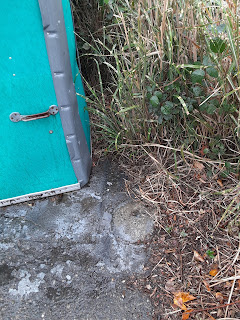


I have no clue at all why those restrooms came down.

That's all I have time to write tonight, dear Diary.  Tomorrow I'll try to finish the story.  Good night.


Sunday, October 24, 2021

Woodland and Green Lake Parks Today

Dear Diary,

Surprise!  I got antsy enough today to go on another hike.

Unfortunately, this turned out to mean another walk through Green Lake Park through an atmospheric river.  My phone didn't react as badly as last time (immortalised in your pages, dear Diary, as "Escaping Green Lake Park, part two" and "Fear of Rain") but I still don't want to connect it to the computer, which may increase the risk of a short-circuit.  I took 47 photos, most of which are water fountain and restroom door shots meant for the Google Drive folders (Woodland, Green Lake), which I hope I can upload today.  But even the exceptions, the ones meant only for you, dear Diary, I may not be able to show you today.  I've left double spaces around the places that I want to put them.  (EDIT 10/25:  They're in now.  My phone survived.)

I skipped the water fountain at the far northwest corner of Woodland Park, for reasons I'll explain.

I started from the northeast corner of Woodland Park, walked south to 50th, then along 50th before turning north again.  I then walked not down West Green Lake Way, but an internal Woodland Park road roughly parallel to it, to enter Green Lake Park near the shellhouse at the lake's southern end.  From there I walked counter-clockwise around the circum-lake trail, past the 64th St and Community Center restrooms to the Bathhouse ones, then moved (and high time, too) to the trail around the edge of the park to visit the wading pool (north) restrooms and the outlying water fountain.

Woodland Park

Erica Barnett at Publicola has recently reported that a sweep of Woodland Park is imminent.  Usually, when she reports something like this, I find myself days too late to actually witness the sweep; in the case of what is currently your most popular page, dear Diary, I was only hours too late.  One of the main reasons many people have been demanding a sweep is that the city has, for many months now, kept both the roads I just mentioned - West Green Lake Way and the internal park road parallel to it - closed; I and also those making these demands believe that these closures were intended to protect a peculiarly favoured homeless encampment centred on the shelters in the western half of the eastern block of Woodland Park.  There have also been demands for a sweep because the presence of so many homeless people prompted enough fear among some housed people that an important annual cross-country track event has been cancelled two years running.

As I approached Woodland Park, I could see cars driving up West Green Lake Way, and concluded that I was days too late once again.

Cloverleaf - Where the four smaller baseball fields along Green Lake Way meet, at the end of a path that continues Clogston Way, there's a building whose roof forms part of the stands for one of the fields.  This building has inside it two restrooms.  These restrooms are normally seasonal, closed sometime in November and opened sometime in March or so, but were considered safe to open limited hours last winter and will probably be opened similarly this coming one, because the other restrooms in the athletic eastern quarter of Woodland Park are closed.  There is a water fountain attached to the building.  I found both restrooms open and the water fountain running strongly.  I delayed a quarter hour because someone of whose gender I was uncertain was standing in front of the women's room sink that entire time, probably making up presumably her face, and finally tried a couple of complicated shots to work around ?her presence.  During that quarter hour I read the front section of today's paper, which I had with me to date the photos.  This turned out to be a good thing.

"Rio" (Citywide Athletics building) - This is a smaller building nestled between the bigger baseball diamond and a soccer field.  The COVID testing site run by Curative is currently still near it, as reported last spring.  Its restrooms were closed today, and the men's room is boarded up, with a sign on the boards announcing it's closed due to vandalism.

The baseball diamond to the south has two water fountains near the first- and third-base dugouts.  Both had been eviscerated by metal thieves when I first visited them in spring 2020.  On this occasion, my first visit since April or May this year, I found running water fountains of the same make there, whether representing major repairs or outright replacement.

Woodland Park Ave - Some way north of where this street ends at 50th, there's a solitary water fountain of an old-fashioned make.  I found it damaged last year, and discerned no repairs so far.

50th St - To the north and west of that water fountain is a restroom building with an extremely old-fashioned water fountain south of it (on the men's room side).  I found both restrooms open (although the women's room door has a damaged "Restroom Closed" sign still taped to it), and the water fountain, which had been damaged since I first saw it, now has a spout again, but still doesn't run.

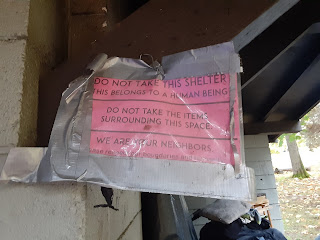
This restroom building is there mainly because of three shelter buildings (Woodland Park's shelters 1 to 3) north of it, on the inside of a loop drive.  Occupation of this area by homeless people during the pandemic has been hit or miss; the main attraction of Woodland Park has been the electricity available from at least one shelter, but none of these shelters have that or even sinks.  That said, this area obviously has not yet been swept.  I didn't even see any of the signs that have recently been posted before sweeps.  I did see signs obviously meant to deter sweeps, similarly on red paper, as follows:


I went north and uphill to the other shelter area, in which four shelters are strung along more or less north-south roads, 7, 4, 5, 6.  Shelter 7 to the south has been the least occupied, but on two visits I'd found campers near it; this time the whole area was empty.


Shelters 4 and 5 didn't appear to be empty.

At the top of the hill, the terminus of the park-internal road that sort of parallels West Green Lake Way, is a restroom building that the Seattle Department of Parks and Recreation calls the "Pink Palace" because it's very noticeably pink.  Its restrooms were open (though the women's room gate had another "Restroom Closed" sign), and the attached water fountains, which I'd found running on no previous hike, were running today.  If I had to guess, I'd guess most of the water fountain work in Woodland Park postdates the June heat wave.  I took two hikes in early July, found lots of water fountains on, and stopped worrying; this hike today was the one I most regretted not doing then.

One of the hallmarks of the encampment around this area has been extension cords used to carry electricity around from the shelter that supplies it to other shelters and to tents.  I remarked on their curtailment in March.  I found this time that they still aren't crossing the main road, but there is again electricity on the other side, around shelter 4, thanks to a circuitously routed cord.


At the northwest corner of this block stands a restroom building the parks department calls "lawn bowling" after the nearby greens.  This is normally a seasonal pair of restrooms; I remember asking Rachel Schulkin of the parks department about them, and her telling me that the manager was trying his best to keep them open.  Over last winter, the "Pink Palace" and "50th St" restrooms were usually open 24 hours, but the lawn bowling pair were only open the same limited hours as the cloverleaf pair.  In any event, they were open this afternoon. 

Under the northern eaves of this building stands a water fountain within the lawn bowling greens' fences.  Today for the first time I found the gate near that water fountain open.


As on a previous occasion when lawn bowlers opened it for me, the water fountain wasn't running.  I have no idea whether that's because of damage or the fence.  (In Tacoma there are many fenced athletic areas, available only by reservation.  I was told by the park worker who let me into one that this resulted in their water fountains never working; but actually, one of the two at that location was on that night.)

Near shelter 6, which I believe to be the main source of electricity (although I suspect what's now crossing to shelter 4 is from the "Pink Palace" instead), is a water fountain.  Last fall, after the city bowed to public health's demands that it turn on the fountains, that was one of only two in Woodland Park that ran (the other was the cloverleaf fountain mentioned above).  It was not running today.

Shelter 6 is the only shelter other than shelter 7 not swathed in tarps today.  It isn't empty like shelter 7; there's a table of books at one end of the shelter and what looks like a table of utensils at the sinkward end.  But none of the cloth, tarps, and whatnot that had made it homelike last autumn for a woman, and later at least kitchenlike last winter and spring for a group of men, remains.

One possible reason the evident enthusiasm for running water fountains didn't reach the fountains at the lawn bowling green and shelter 6 is that there are extension cords across the road near there.  I think this is more likely to have been accepted as a good excuse to skip those fountains (conceivably even by agreement among some park workers and some campers), than to be the result of extremely pugnacious campers who wouldn't even temporarily detach those cords.

In my trip today, the rain got a lot steadier around here.  I reflected on the fact that the water fountain near Woodland Park Ave is the same make as the water fountain at the park's northwest corner, that is, the northwest corner of the block the Woodland Park Zoo is on, and decided that the latter fountain was unlikely to have been repaired and I didn't need to cross Aurora to verify that.

Green Lake Park

At the south end of the lake used to be a Shellhouse Theatre or some such.  One part of their seating survives.  Clockwise along the trail from there are the two buildings of the current Green Lake Small Craft Center.  One of those buildings holds two restrooms, which I found open.  Each building has attached to it one water fountain, which ran during the first drought of spring 2020, but not during the second one of spring 2021.  Both were running today.

Green Lake Park's circum-lake trail had, for all the months of my acquaintance with it, a profusion of signs.  "Crowded Parks Lead to Closed Parks".  "Wrong Way".  And so on, and so on, and so on.  I saw basically none of these today.  Indeed it was far from clear whether we were still in pandemic-time rules, in which wheels were barred and everyone walked counter-clockwise, or in regular rules, which are completely different.

I, like most people, went counter-clockwise, not least because that's how I'd planned the hike.  Counter-clockwise, then, the next restrooms, the parks department calls "65th Street" because they're near where 64th Street ends at East Green Lake Way.  Ahem.  The official 24-hour restrooms of Green Lake Park used to be further north, but perhaps because of the encampment relatively nearby, last winter the 64th St restrooms were officially open 24 hours instead.  (In reality, both pairs were normally open 24 hours.)  Unsurprisingly, I found the 64th St restrooms open today.  I've never found a water fountain near them.

The Green Lake Community Center has restrooms whose doors open to the outside.  Last winter there was renovation going on, resulting in unpredictable access to those restrooms and, separately, unpredictable water supply.  Thankfully, not only were they open today, but also the men's room, at least, had both warm and cold running water and unblocked toilets.  (However, the men's room was less affected by the renovation throughout, so the women's room may or may not have the same.)  The water fountain trailward of the Community Center was running.

As I walked north from the Community Center the wind got considerably stronger.  I had to furl my umbrella, which did not do wonders for my comfort or the cohesion of the newspaper front section I was carrying to date the photos.  The wind started to break branches off trees and whip them at the people walking the trail, including me; I found seven tiny twigs in my hair while writing this page, dear Diary.  This made me more certain that my planned path, arguably shorter and not requiring me to go back along the lowest parts of the lake trail, was the right one.  So on I went to the Bathhouse Theater.

This building's restrooms have doors that open to the outside, but they're one of three sets of those in North Seattle that officially open only in summer, when I generally avoid hiking.  (The other two are in Magnuson Park and at Matthews Beach).  However, they were open last winter.  I did not find them open today.  There's a freestanding water fountain near the men's room, running today, and attached fountains on the other side of the women's room (lakeward), also running today.

So then I went out to the park's edge, and started back clockwise.  This brought me to the usual official 24-hour restrooms, near the northernmost point of the lake; the parks department refers to these restrooms as "wading pool" after a nearby feature.  They weren't the official 24-hour restrooms last winter, but were open 24 hours most nights anyhow.  Of course I found them open.  The water fountains attached to the building were running, as was the freestanding water fountain nearby.  (EDIT 10/25:  I didn't end up with photos of that fountain, and am not positive I checked that it was running.  Sorry, dear Diary.)  The newspaper section was disintegrating, and my phone was doing weird stuff all the time.  This was pretty much the trip's nadir.

So from there I went back to the park's edge and looked for a freestanding water fountain I'd found this spring for the first time, around where 72nd St intersects East Green Lake Drive.  This fountain had run for a while and then been vandalised.  I think it's been partly fixed, but it still doesn't have a spout, and I didn't hear water when I pushed the button.

The weather suddenly turned much nicer around the time I took the last photo, and I made my way home.  The last stop was the neighbourhood shop where I'd bought the paper; I bought another copy, because it was hopeless to salvage the section I'd carried all that way.

Dear Diary, I don't understand why I didn't see sweep notices already up, and why it looks like things have improved again for the campers at Woodland Park.  The most important change is that the roads are open (and the park-internal road seeing frequent but not constant use), but at least by day, I didn't see vigilantes trying to harm the campers.  I find it hard to believe our present mayor has finally decided to be nice to homeless people, but that hypothesis fits the current facts better than any other I can think of.  Perhaps sometime in the coming days the confusion will be reduced.  But for now, the people in Woodland Park remain relatively fortunate among the unsheltered homeless of this pandemic, as, of course, still more so, am I.  Good night, dear Diary.


Saturday, October 23, 2021

Magnuson Park Today

Dear Diary,

I spent several hours in Magnuson Park today.  This was mostly for upcoming pages, which still need other work, but partly also the beginning of whatever I'll be able to do by way of a final water fountain and restroom hike of North Seattle before most of the former and some of the latter get closed for winter, in other words, the meat-and-potatoes work of door shots and such that so many of your pages, dear Diary, consist of.

So of the four sites I track at the Google Drive folder for Magnuson Park, here's the rundown:

Entrance - Restroom doors closed.  These are only supposed to be open in summer, and I haven't visited Magnuson Park for you during summer, dear Diary, so I suppose this is unsurprising.  However, considering that these restrooms are inside the "Brig", and I found this on a door to the Brig itself today:


it is still beyond me to explain why those doors haven't been open daily from the pandemic's beginning to this very day.  Did someone brightly design them to open into the building as well, so hygiene within requires the outer doors to remain closed?

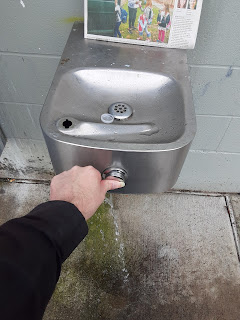
However, in other news, the water fountain near the playground was running.  This is the first time I've found it running since you began, dear Diary.  Its drain was clogged, probably by sand, so I'm not going to show you the dispiriting photo, but still, this is good news.  (That photo, all those in this page, and more, are, of course, in the Google Drive folder.)  Good news, yes, but there are trade-offs ahead.

Central - The water fountain was also running, not that that's a huge surprise any more.  However, the restrooms were all closed.  I found what's either a second door to the women's room, or a separate women's room from the one I'd known about before, around the corner from the doorways already familiar to me.  There was very little explanation of the closure - only the women's room, as usual, still had the closure sign with four boxes to check, only none were checked.  The door I hadn't noticed before, or else had forgotten before ever telling you about it, dear Diary, had a slightly more informative sign about "emergency repairs":


There's worse to come, though.

Beach - The restrooms were as usual - little privacy (as I remembered unhappily when, later on, I needed to use them), no working dryer in the men's room, but the kind of soap the Department of Parks and Recreation was supplying at the start of the pandemic, not the rather worse kind they'd switched to sometime last fall - so only that last was a mild surprise, and a good one.  Outside, the showers were running, though I didn't try to take a photo this time.  However, the water fountain - the attached water fountain, attached to a building with a furnace, which in a better world would run all winter - well, I've recently shown my own ineptitude at diagnosing damage to water fountains, but the spout and the drainpipe are both missing, so the obvious explanation, I think, is metal thievery.


Tower - Nothing meaningful had changed at this closed, closed, closed site.

So for drinking water, visitors to Magnuson Park today had as their best option the central water fountain, but could also brave the playground one; but for a sink, only the beach restrooms were available.  That's also where the only flush toilets were available, but as always, Magnuson Park has plenty of the other kind.

This is the biggest park in North Seattle.  One of the upcoming pages will, I hope, explain how this gigantic park came to this preposterous pass, but that isn't this page's task; this page is just about telling you what I found today.

I hope to start writing those upcoming pages maybe Tuesday, but it'll depend on the utilities where I live; the Wi-Fi was out this morning, and nobody knows what tomorrow's predicted storm might do to the electricity.  Until we meet again, dear Diary, happy days.


Friday, October 15, 2021

A Bit Less Neglect

Dear Diary,

Today, for what turned out to be stupid reasons, I walked home from work.  My route took me to Lake Union Park, which is at the south end of Lake Union, and that reminded me of something I should probably discuss with you as soon as my schedule allows.  Hint:  It has to do with my brief appearance late in a video available at this link.

Oh, OK, another hint.  See if you can figure out, dear Diary, what's out of date about this neato-coolo map of Lake Union that the parks department has put up at Lake Union Park:


Meanwhile, the Seattle Public Library has re-opened the New Holly branch.  With its own distinctive schedule.  So there are now fourteen schedules for the twenty-seven branches.  There are still only twelve open seven days per week; New Holly is closed Fridays and Sundays, which is unlike all the schedules except the one for Green Lake, Madrona and Wallingford.  But it's open Saturdays, which those three libraries haven't managed to do yet.  Hence, another unique schedule.

I'm not checking all the university libraries' hours again tonight.  I did stop at Seattle Central College a few days ago, but it turns out I was too late for its library, so it doesn't actually mean anything that I found the door locked.

So that's all for tonight, dear Diary.  Until later, then, happy days.

Saturday, October 9, 2021

Library Hours in Month Twenty of the Lockdowns

Dear Diary,

Yes, it's been a long time.

I ran into trouble trying to make a map of Tacoma, and used that as an excuse to stop trying to write in you.  As a result, I've made much faster progress in resuming parts of my pre-homeless life (including, at the moment, a full-time temporary job) as well as parts of my homeless life unrelated to you.

The most related to you of those parts is the spreadsheet of library hours that I'd already uploaded to this public folder in my Google Drive space.  I just finished updating that today.

Some comments:

Seattle Public Library hours

One roadblock was something I avoided facing as long as all branches of the Seattle Public Library were open on the same schedule every day - either 10 A.M. to 6 P.M. or closed Monday through Saturday, either noon to 6 P.M. or closed Sunday.  But once they started trying to resume approximations of their pre-pandemic schedules, it was impossible to continue the spreadsheet the way I'd been doing it, keeping each library in its pre-pandemic hours bucket.

By this I mean that before the pandemic, Seattle Public Library branches kept just four schedules.  About half kept this:

  • 10 A.M. to 8 P.M. Monday through Thursday
  • 10 A.M. to 6 P.M. Friday and Saturday
  • Noon to 5 P.M. Sunday

These are the libraries my spreadsheet used to sum up as "Big".  Central Library kept the same schedule except that it was open until 6 P.M. on Sundays.

Four libraries, which I summed up as "Medium", kept this schedule:

  • 1 P.M. to 8 P.M. Monday and Tuesday
  • 11 A.M. to 6 P.M. Wednesday through Saturday
  • Noon to 5 P.M. Sunday

And the rest, which I summed up as "Little", kept this schedule:

  • 1 P.M. to 8 P.M. Monday and Tuesday
  • 11 A.M. to 6 P.M. Wednesday, Thursday and Saturday
  • Closed Friday
  • Noon to 5 P.M. Sunday

Four schedules for twenty-seven branches.

There are now twenty-six branches open, and they are keeping *thirteen* schedules.  Eight of the big libraries are keeping a single schedule, but each of the other five has its own schedule.  Central has its own schedule.  Each of the medium libraries has a different schedule, but University shares its schedule with two little libraries.  Three each of the little libraries follow two other schedules.  I list the thirteen schedules below.

The only libraries that are keeping their pre-pandemic schedules are Fremont, High Point and Montlake.  No library is open longer hours than before the pandemic any day of the week, which is a change from the summer, when all the small and medium libraries that were open on Mondays through Saturdays, and all libraries open on Sundays, were keeping longer hours each day they were open (eight hours vs. seven M-S, six vs. five Sundays).  Of course, now that each re-opened library is open at least four days of the week, and most five to seven, the total hours most libraries are open have expanded considerably.

Related to hours, I've found yet another lie from city government.  The most recent hours announcement from SPL claims "Beginning Sept. 1, most reopened branches will be open every day of the week."  This isn't even close to true.  Here's a list of schedules:

  1. Ballard, Broadview, Capitol Hill, Douglass-Truth, Greenwood, Rainier Beach, Southwest, West Seattle (main big schedule) - in fact open seven days
  2. Beacon Hill (big) - in fact open seven days
  3. Central - in fact open seven days since September 15
  4. Columbia (big) - in fact open seven days
  5. Delridge, Magnolia, Queen Anne (little) - closed Fridays and Saturdays
  6. Fremont, Montlake, University (little/medium) - closed Fridays
  7. Green Lake, Madrona/Sally Goldmark, Wallingford (little) - closed Fridays, Saturdays and Sundays
  8. High Point (medium) - in fact open seven days
  9. International District/Chinatown (medium) - closed Saturdays
  10. Lake City (big) - closed Sundays
  11. Northeast (big) - closed Saturdays
  12. Northgate (big) - closed Mondays
  13. South Park (medium) - closed Sundays

So on September 1 (when Central Library was still closed Sundays and Mondays), eleven of the twenty-four then-reopened branches were open seven days of the week.  On September 15, twelve of the twenty-six.  How is this "most" ?  Before the pandemic, eighteen of the twenty-seven were open seven days.

In case I don't actually get around to the three remaining pages intended about Tacoma, I feel obligated to note something about the Tacoma Public Library.  They re-opened to their full schedule in early July, all but one branch, modulo some construction at their Main Library.  They keep significantly shorter hours than Seattle's Central, big and medium libraries, but they restored the hours they do keep before anyone else in the neighbourhood.  I'll steal another bit of fire from the Tacoma pages by noting that the librarian at Pierce County Libraries' University Place branch who told me that the Tacoma libraries, like the Pierce County ones, also had disabled their water fountains - well, maybe she believed that, in which case it wasn't an outright lie, but it certainly wasn't true.  As best I can tell, the Tacoma libraries' water fountains were available as soon as those libraries re-opened.  And the branch that librarian specifically mentioned provides good water.

University library hours

I first started keeping the spreadsheet after I'd essentially started living at or near the University of Washington, so it's always included a bunch of university libraries.  They currently present a big contrast with the Seattle Public Library.  The latter wants us to believe that most branches are open seven days a week even if it's not true; all university libraries to which I've paid attention are unapologetically closed to the public on weekends at present.

The public university and the private universities present, between them, three patterns.

University of Washington

The University of Washington branches to which I've paid attention include Suzzallo, Odegaard, Health Sciences, East Asia (now Tateuchi East Asia), Law and Music; I was intending to get acquainted with its Drama library when the lockdown came.  I've also spent a day or two at the Tacoma branch's library, but haven't made it to the Bothell branch's.

Before the pandemic, each branch kept a different schedule, and I was selective listing them on the spreadsheet - always Suzzallo, Odegaard, and Health, but I replaced Law (that is, the Gallagher Law Library) with East Asia at some point.  My visits to Health and Law were sometimes motivated by research - into the human senses (at Health) and into oddities of marriage relevant to income taxes (at Law) - but also by Law's proximity to the edge of campus, when I slept on Roosevelt, and by computers once available at both that allowed the general public to reach the entire Web, as opposed to the usual public computers at UW's libraries that block a confusing and changing set of domains.

Law didn't like people like me intruding on it, and so gradually changed many of its ways.  First it got rid of the public computers.  Then it designated the places I preferred to sit as restricted to people affiliated with the Law School.  Finally it insituted a sign-in requirement for the general public.  Since I haven't worked as a tax preparer since the sign-in went into effect, I haven't been back.  But I think it's a pity that Seattle closed its municipal law library, relying on the UW's, only for this to happen.  (There's still a King County Law Library, though.)  Anyway, today, the Law library is closed not only to the general public, but to the general body of UW's students, faculty and staff; it's open only to Law School people this quarter.

(The GoFundMe that got me housed was started by a woman who'd been a law student when I used to visit the Law library, and had seen me there.  So I have more reason now to regret the Law library's hostility than I had before the pandemic:  it's cut off a chance for similar interactions, if that's the right word, to happen that might benefit others.)

Two libraries whose hours I still tracked are closed to the general public this quarter - Odegaard and Health.  Odegaard's closure has been explained.  Odegaard used to be open to students 24 hours most of each week.  Since this presented a serious temptation to the homeless in the vicinity, when the University began opening it 24 hours, it also instituted a closure to the general public.  At 8 P.M., anyone without a current University ID card would be kicked out.  They got tired of the hassle of doing this, so now they're just closed to the general public entirely, this quarter at least, as an "experiment".  My main purposes in Odegaard were to look at the new book tables (Suzzallo stopped presenting new books in a special area long ago, I think before I became homeless here), and to read books Odegaard had but other University libraries didn't.  Assuming I get a library card, I'll be able to page those books from Odegaard, but probably not go back in to look at the new books.

(Odegaard is the "college library", so you might think, dear Diary, given that I've admitted to you that I'm an ogler, that ogling would be another reason I'd go there.  But that's silly.  There are undergraduates all over the UW campus, and nothing about Odegaard makes the ones there more attractive than the rest.  Also, most of its men's rooms are rather repulsive.)

Odegaard's closure reminds me of the reason I skipped two grades in grade school.  This was not because I was so very smart.  It was because I was smart, and so very disruptive, at a specific time.  I remember making up a song insulting a student teacher, in first or second grade, and I'm pretty sure I was difficult in other ways.  Anyway, an eighth-grade teacher got the bright idea that I should be in his classroom instead.  I wasted much of a semester there learning nothing, then when that teacher finally got fed up with me, spent the rest of second grade being taught in a coat room, separate from the rest of the class.  So I was pretty famous in the school by the next summer, when there was a teachers' strike.  The teachers won, were feeling their oats, and every single third and fourth grade teacher refused to admit me to their classes.  So I wound up going from second grade to the classroom of a fifth grade teacher my mother begged to take me.

Similarly, the pandemic has afforded the university libraries a chance to change their relationships with the public, and they're seizing that chance.  We'll see this again at the private schools, but Odegaard is another example.  I never went back to third or fourth grades, and I rather suspect I won't see the indoors of Odegaard Library for years, if ever.

I haven't seen any similar explanation for the closure of the Health Sciences Library to the public, but given how many of the public state- and nation-wide, if not so much in King County, are unvaccinated and refuse to wear masks, I'm pretty sure if it were explained, it would be on that basis.  In any event, Health got rid of its open-web public-access computers not long before the lockdowns (partly because I used them to copy YouTube links for a substantial set of postings to Usenet I was doing), so unless I resume my research into the human senses (unlikely while this book remains permanently checked out), I'm unlikely to have much reason to go there.

Anyway, complete closure is one pattern the University of Washington's libraries are presenting to the public.  The other one is libraries open to the public 9-5 weekdays (Suzzallo, East Asia) or 1-5 (Music, Drama).  The explanation for this is that the libraries weren't able to hire and train undergraduates to help run the libraries in the run-up to re-opening this fall, so they can't resume their normal hours yet.  I don't know how quickly they intend to do so, but have been told that hours aren't likely to increase this quarter.

The Tacoma branch's library is open rather longer hours than 9-5 already, but still not on weekends.

Private universities' libraries

Before the pandemic, most private universities' libraries in this area were open to the public, although they provided widely varying levels of Internet access.  City University of Seattle was an exception, emphatically closed to the public, and I never had a reason and a way at the same time to get to Northwest University in Kirkland, so don't know about it.  But I've spent significant time at Seattle University's Lemieux Library and Seattle Pacific University's Ames Library, and visited more than once each Pacific Lutheran University's Mortvedt Library (in Parkland) and the University of Puget Sound's Collins Memorial Library (in Tacoma).  However, in early 2019, a forerunner to today's pattern went into effect at Lemieux.

All four of those libraries - SU, SPU, PLU and UPS - are now using a considerably more severe version of the policy Lemieux instituted in January 2019.  This policy is less restrictive than the one Odegaard gave up, but it interacts with COVID-19 restrictions to make it really problematic.  Essentially, this policy is a curfew.  Entry to each library after the curfew, and all day Saturdays and Sundays, requires a university ID.  At SU, whose curfew used to be 8 P.M., it's now 6 P.M., and PLU now has the same.  At SPU and UPS, the curfew is now 5 P.M.  People who get in before the curfew can stay, but as far as I know, can't re-enter if they leave.

These curfews struck me as ironic.  When I was homeless, it wouldn't have been much trouble to meet these curfews.  But now that I'm housed and working, it's really hard.  Given what I'd observed at UW's Law library, I figured at least part of the motivation for the curfews is to keep homeless people out, but if so, the libraries were going at it backward.  On September 23 I wrote to each library's general contact e-mail address saying so.  Three people have written back:  a reference librarian at SPU, and the heads of SU's and PLU's libraries.  The SPU librarian said "I know of no determination to make any of this permanent."  The SU dean specifically noted that barring the general public on weekends was meant to free up space for SU students and faculty, and gave no hint that anything currently happening *isn't* permanent.  The PLU director didn't say much.

Given that current mask requirements bar eating and drinking, it's much less comfortable to spend hours continuously in a library than it was in the past.  So the curfews interact with COVID issues in two unpleasant ways:  People who think ahead will have to postpone eating or drinking until they're ready to leave the library altogether.  People who don't think ahead will find themselves locked away from some of their property.

Seattle University's Law Library used to charge members of the general public $5 per day to visit; that fee may have been waived for me the one time I remember going there (for a novel, of all things, if I remember correctly).  It's currently closed to the public.

Community colleges' libraries

The Seattle community colleges' libraries have long been worse documented online than the other libraries discussed in this page, although they appear now to have Web pages of their very own:

  • Seattle Central College's library says it's open, apparently to the public, Mondays through Thursdays; this is sort of consistent with signs I saw on a recent visit to its Capitol Hill location (though I didn't go inside)
  • North Seattle College's library is apparently undergoing renovation.  I'm not sure to whom and under what circumstances its temporary home is open.
  • South Seattle College's library is not yet accustomed to updating its Web page, which currently announces that during fall quarter 2021 it will offer item pickup.
(I should also note that South Seattle College doesn't have the only library unaccustomed to updating its Web site.  For years, the only reliable way to get Lemieux Library's hours on certain occasions, notably snow days and at quarters' ends, was to go there, which sometimes resulted in my being questioned by Seattle University public safety officers, since Lemieux is the only SU building open to the public, and I usually visited at times when it wasn't open.  I think this had changed more recently, so hope it'll change sometime soonish at South Seattle College.)

One thing I've been doing in the months I've been ignoring you, dear Diary, is re-compiling a list of non-fiction books about Korea that I built and then lost in one of my many electronic vicissitudes while homeless.  Several local community colleges' libraries outside Seattle report to Worldcat having some of these books that aren't at the UW, so in principle, I'd have reason to care about access to Highline College, Renton Technical College, Shoreline Community College, and others, as well as Northwest University.  However, at all these schools, any time I've actually clicked the Worldcat-provided link, it's turned out they've gotten rid of the book.  So for the time being, I'll stop picking on the small fry.

My experience of being at SCC's library is of having no Internet access (except on my phone, once I had a smart phone).  Librarians there told me that state law somehow bars the community colleges from offering Wi-Fi to the general public.

All for now, dear Diary.  This is, of course, all somewhat off-topic for you, but not really.  At a minimum, what I'm reporting is restrictions on the hours some restrooms I mapped for you a while ago are open.  Anyway, happy days until I can get a map of Tacoma made, or spare time to go on a water fountain hike of North Seattle.


Sunday, July 18, 2021

Seattle's water fountains and the June heat wave

Dear Diary,

In today's Seattle Times, a front page story indicates shut-off water fountains (sigh, park drinking water fountains) as one of Seattle's heat wave preparation failures.  Now, you and I documented those shut off fountains in May, but a comment on one of your pages, dear Diary, and a fountain I've observed repeatedly for myself, but not yet told you about, showed that during June, the city had turned at least a few more on.  And after the heat wave, we've found and revealed numerous park fountains on that were off in May.

Furthermore, Seattle Public Utilities, before the heat wave, published a pseudo-map of running street water fountains.  It was incomplete, and it lied some, as I've documented since belatedly learning of it, but most of the fountains it lists that I've checked both exist and were running when I found them, as were a bunch of the fountains it omitted.

From my perspective, having followed Seattle's water fountains desultorily for years and rather more assiduously for the past year-and-some, Seattle's water fountain response to the heat wave wasn't a failure.  It may not have been any better than a C, but it wasn't a failure, and at the very least, post-heat wave, Seattle is heading towards an A.  (It is not, in this case, stupid to close the barn door only after the horses escape.  There could very well be more heat waves this summer.)

Let's back out.  The excuse officials have used, probably coast to coast, but certainly around here, to save on water bills by shutting off drinking water fountains, is a valid excuse, it just isn't a good one.  Early in the pandemic, dear Diary, even later than when you were born, it was accepted wisdom that COVID-19 could be spread by touching a surface on which the virus was concentrated.  This is what underlies the mania for sanitiser that has driven much of this country's hygiene theatre this past year and more, for example.  This accepted wisdom was wrong, however, or at least beside the point:  maybe it really is possible to catch COVID-19 by touching infected surfaces, but it's much easier to catch it by breathing, and that's how the vast majority of patients caught it and are still catching it.  You may remember, dear Diary, that at the same time as this touch thing was believed, we were also being told not to mask.  That's how committed, in particular, the CDC was to the touch theory.

Even after the CDC backed down, which it did far too late last year, it continued to represent the touch theory in its detailed pages, notably those relevant to outdoor water fountains.  My belief is that it did so because what those pages actually called for was frequent cleaning ("at least daily"), and cleanliness is next to godliness anyway.  Yes, I really think the CDC maintained that advice, thus justifying this year's Durkan Drought, on the basis of something that unrelated to COVID-19 and unresponsive to strained municipal budgets.  Most of the advice in the main page cited in this context isn't really relevant to outdoors (the rarity of outdoor transmission is another thing the CDC was slow to admit), but when I researched this on May 18, a more often updated FAQ specifically recommended against trying to disinfect sidewalks.  However, a page about buildings, of all things, gives reasonably clear outdoor-specific instructions, and backs up this idea of washing outdoor water fountains.

Now, dear Diary, if any of your readers have been checking those links, they've found that the main page about parks, the first link in the previous paragraph, has effectively been cancelled.  It's "no longer being updated".  The Internet Archive shows that this notice was inserted sometime between June 9 and June 24 of this year.  Far too late, but still before the heat wave.  A city that was thinking of publicly available water as a Good Thing, that it should try to offer its citizens, would have checked that page regularly, and noticed that notice before I did so this morning.  For all my complaints about Seattle's policy throughout the pandemic, it seems clear that Seattle did that, hence the changes announced in June and those I've found so far in July.

It's hard for me to believe that I'm defending the City of Seattle, on water fountains, against my friends at the Seattle Times, but it's true, dear Diary.  Now let me recover from that shock for a while before explaining how Tacoma's response has differed.


Saturday, July 17, 2021

The Grass Isn't Always Greener: Tacoma, part I

Dear Diary,

Under a slightly longer version of my name, I maintain about a hundred playlists at YouTube.  Nearly all, and all the public ones, came about because I watch Korean TV dramas.  The most popular are playlists that reproduce individual dramas' soundtrack albums.  But those are a minority of the total.  The rest instead concentrate on a few specific musical performers I first encountered through dramas:  Jisun, the ChungWonYoung Band, Jadu, and IU.

IU is much the most popular of these, partly because she's an "idol".  As a result, most of her work has been on YouTube throughout her career.  In contrast, some of the ChungWonYoung Band's still isn't there now.  As for Jisun and Jadu, both were lead singers of bands that were about equally popular in their heydays, but maybe because The Jadu's heyday was a few years earlier than Loveholic's, or maybe for some other reason, Jisun's career has mostly been documented at YouTube all along, but not so much Jadu's.  However, it became clear, when I built all my IU playlists, that Loveholic wanted some of its music kept off YouTube, so I was nervous, and only made private playlists concerning Jisun.  I built one public Jadu playlist, but nothing else was at YouTube at the level of individual songs, so I went no further.

This was all years ago.  In February 2016, for some reason, I stopped updating the spreadsheet I used to keep track of the playlists, and in November 2017 my laptop was stolen, after which it was hard to do much of anything with them.  So once I got the laptop I'm writing on now, one of my first concerns was to do what I could to repair years of neglect.  I'd always done updates on the 15th of the month, so on June 14 I started, and on June 17th finished.

And since YouTube has aggressively been acquiring Korean popular music since I'd last worried about the playlists, I then made public the (repaired) Jisun playlists, and started working on Jadu ones.  Much of her work still isn't there, but quite a lot is, including much of what I love most.  (She is, so far, the only Korean performer all of whose discs I own.)  However, the songs that interested me in her in the first place were ones she sang as a character in a drama.  The network that first aired that drama used to have the whole thing available at YouTube, though without subtitles, but now offers only part of the fourth episode.  So I thought maybe it was time I figured out how to violate copyright at YouTube - no, not to upload the whole drama, but maybe the individual songs - and in order to decide, looked for the DVDs I'd first watched.

The Seattle Public Library has long ago disposed of its copies.  The easiest place for me to get them now was the University Place branch of the Pierce County Library, so off I went, on July 3.

And that's where you come in, dear Diary.

Pierce County Library, University Place branch

Once I'd picked up my hold, and picked another couple of dramas, it occurred to me to check the restrooms and water fountains.  But I didn't get very far, because I was shocked to see the water fountains like this:


Mind, I wasn't shocked just because the water fountains were disabled.  Disappointed, yes, but not shocked.  What shocked me was that the Pierce County Library had considered it reasonable to spend money for the sole purpose of disabling its water fountains!  As we've seen, the Seattle Public Library was disabling some of its water fountains, for social distancing purposes, but it was just using plastic bags to do it.  PCL wasn't doing it for social distancing, and had thought it more worthwhile to buy these things than to buy books.  I was shocked.

So I asked a librarian about it, identifying myself first as your writer, dear Diary, in other words as sort of a member of the press.  This librarian said it was "because of COVID", to "keep everyone safe".  She also said all the PCL libraries were doing this (I don't know the current status, but did later find one other library doing so), and not only that, but the Tacoma Library branches too, in particular the Swasey branch "just up the street".  (We'll get to the truth of that statement later, repeatedly.)

Obviously, the myth that COVID-19 spreads through touch is still widespread in Pierce County.  In fact, absurdly widespread.  Outside the University Place Library, there's a sort of fountain or perhaps water play area.  Adjacent to it stands a double water fountain (plus a bowl down at the bottom, probably for dogs).  And as of yesterday, that water fountain - outside, where COVID-19 spread is even less likely - was still turned off.  But these are the photos I took on July 3:


In University Place, if you want to drink water, you need to drink it from display fountains, not drinking fountains.  Probably to this day.

But that's all I have to say about University Place, which is not a very big place and may be prone to silly ideas.  I was horrified by the idea that a major city like Tacoma would be the same way.  So on finding through Google Maps that a bunch of large Tacoma parks were on the bus route I was taking, I got off and started an excursion.

Wait Demons

I got off the bus rather too soon, in fact, and this is how I discovered that one of the things I like least in Seattle is even more present in Tacoma.

Pedestrians approaching intersections may find one of three things there, in one way of looking at it:  timed traffic lights, push-button traffic lights, or no traffic lights.  (Some lights with push-buttons are actually also timed.)  In recent years, Seattle has enthusiastically been installing a particular kind of push-button light, each of which, when the button is pushed, starts yelling "WAIT!" once per second until the light changes.  Since this yelling is punishing only the obedient, only those who actually do wait, it is obviously perpetrated by a demon.  The only thing that makes Seattle's penchant for this kind of traffic light tolerable is that the demons' voices wear out fairly quickly, so until they're replaced they can be ignored.

Well, Tacoma has far more push-button lights than Seattle, on many intersections that would here either have no lights, or have timed ones.  And a far higher percentage of Tacoma's push-button lights have wait demons in them.  And not only that, but Tacoma is much more diligent in summoning new demons when the old ones' voices wear out.  Those who don't like being yelled at should re-consider any plans they may make to go hiking in Tacoma.

But anyway, I'd started

A Hike in Western and Central Tacoma

The first place Google Maps pointed me to, it called "China Lake Park".  It's quite large, so I figured for sure it would have restrooms and a water fountain, and I could see where things stood.

China Lake Nature Area


Oops.  A while later, as I continued on 19th, I saw this fairly incongruous sign:


I'd already found that one of the trails marked on Google Maps was probably made by someone other than parks staff, and on seeing the information that people not members of the public would be punished for intruding, decided to give up.  (After all, I'm not a member of the version of the public that pays for Tacoma's parks.)  Seattle's Natural Areas don't have plumbing, after all; why would this park?

Heidelberg Sports Complex

This is also called the Heidelberg-Davis Sports Complex, or Heidelberg Park.  I walked along its north side (19th) and part of its west side (S Tyler St), and found nothing but fences.  Along the west side was a sign announcing Foss High School, so I figured it was just something like the Seattle parks' deal with Nathan Hale, and dropped it.  In yesterday's hike I went back and found I'd gotten things wrong, but all in good order.  On the 3rd, I crossed Tyler to

The Tacoma Nature Center

I was to find that many of Tacoma's parks are mapped, a much higher proportion than of Seattle's parks.  Here's one:


Now, this map doesn't show any plumbing, but that could just mean it wasn't intended to, not that there wasn't any, and there were buildings nearby, so I plodded on, and found these things:


See?  At least Tacoma was being more parsimonious than the Pierce County Library, if not more generous with water.  I returned to this park, also, yesterday.

DeLong Park

This is another large park like the Tacoma Nature Center and China Lake Nature Area, but this one is officially an actual Park, see:


It too is mapped.

I was getting tired of not checking these maps out, so I went into the park.  At its north end is a big grassy sward with a few benches.  Towards its middle is a tree-ringed clearing with one.  That's basically it for amenities in DeLong Park.

I was beginning to get the impression that the Metropolitan Tacoma Park District (which provides parks to a few small areas outside Tacoma's own boundaries) was a hardcore park purveyor, for which benches were extravagant luxuries.  I think it's true that in general, Metro Parks Tacoma (as it's now known) wants more hiking than Seattle's Department of Parks and Recreation, and although Tacoma is a much smaller city with far fewer parks, it may offer more hiking and certainly offers more hiking maps.  But the next park I went to was very different.

Franklin Park

This is the first of these parks where I found the following things:

  • A playground
  • A picnic shelter
  • Restrooms
  • A playfield, on which a game involving a soccer ball was happening
  • Crowds, watching the game

It's also the first of these parks where I didn't find a park sign like the one I just showed you, dear Diary, for DeLong Park.

But it was like most of the others so far in lacking a water fountain.  This, right there, is distinctive by Seattle standards.  At least in North Seattle, all parks with restrooms have water fountains.  Not in Tacoma.

Anyway, here are the restrooms' doors:


There was a line of women waiting to use those restrooms, so even if I'd had a newspaper with me to date the photo, I wouldn't have tried for open-door shots.  You'll just have to take my word, dear Diary, that the doors were in fact opening.  Because most of the restroom doors I've photographed in Tacoma are single-user stalls' doors, in fact, they aren't set up to stay open, and in all my hikes so far there, I've taken few such shots.

And here's the sign I did find and photograph, after circling the entire park, futilely looking for the name sign:


I returned to this park yesterday too.

Peck Athletic Complex

Remembering that I'd ditched Heidelberg too soon, I did circumnavigate this much smaller park, and found the place where the fence would open, if it did open.  I saw a building in there, which I inferred had restrooms, but it doesn't look like my photo caught that.


Here's the sign:


Stanley Playfield

Google Maps shows two parks here:  Stanley Playfield on the west, Sewell Park on the east.  Google is quite sure Sewell Park is a real place, but Metro Parks Tacoma doesn't know of it, and doesn't have any signage up naming it.  (Really.  I explored this park quite thoroughly, looking for that sign.)

Anyway, Stanley Playfield is adjacent to a school, which has weird results here.  Something I took at first for a weirdly built and weirdly empty picnic shelter is actually, on the school side, a sheltered basketball court.  Next to that are two playgrounds, one for the school, one for the park.  The park seems to have no plumbing, and it was getting pretty late, so I just photographed the sign:


Ferry Park

This is Tacoma's oldest park, at least according to the local signage.  It has a playground and a lawn, and not much else.


Oh, you wanted to see the historical signage, dear Diary?  I photographed that too.  Turns out this small park has had a pretty contentious history, going back and forth on whether playgrounds were appropriate to it, of all strange subjects for arguments.


Water, Water Nowhere, and Nary a Drop to Drink

As I headed on toward downtown and my bus back to Seattle, I passed a service agency.  It had a poster up, prompted by the then-recent heat wave:


That lists cooling centres and places to get water bottles.  Too much trouble to turn some water fountains on, much better to waste plastic and money on water bottles.  That's how Tacoma's homeless were told to deal with the hottest weather in the city's history.

Much of what I learned on the 3rd of July about Tacoma turned out to be false, as future pages will show, but as far as I now know, it's true that the city's solution to homeless people needing water, not just in that heat wave but throughout the pandemic, was bottles.

Tonight, however, it's approaching quiet hours, and the drama I'm currently watching I still have two episodes left in.  So I have to get back to that.  That drama, which I'm beginning, on this second watching, to believe is really excellent, is available free at a site called Viki, which also has the (somewhat worse) drama I found Jadu in, but that's paywalled.

So the next page about Tacoma is coming tomorrow.